


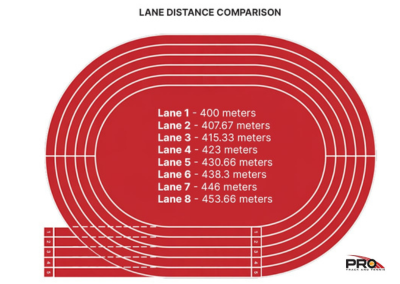
Most people assume every running track is identical, a simple oval where one lap equals a quarter mile. In reality, the length and geometry of a track vary more than you might expect. The familiar 400-meter oval is the global standard, but many schools, indoor venues, and land-restricted facilities rely on alternative layouts that change how far each lap measures and how the track performs over time.
For facility managers, these details matter. Track length determines how athletes train. Lane count affects daily use and long-term maintenance. Geometry and available space influence drainage, resurfacing schedules, and construction costs. Understanding how track dimensions work, including how many meters each lane covers and how many lanes are required for your program, helps you plan upgrades, manage budgets, and avoid costly design mistakes.
If your existing track is showing signs of wear, investing in professional running track resurfacing can restore performance and extend the life of the facility before a full replacement becomes necessary.
Whether you’re evaluating a new track, reviewing an aging facility, or simply fielding questions from coaches about lane distances, this guide explains the standard 400m layout, lane-by-lane differences, indoor and 300m alternatives, and the practical implications of each configuration.

The Standard Running Track Length (400m)
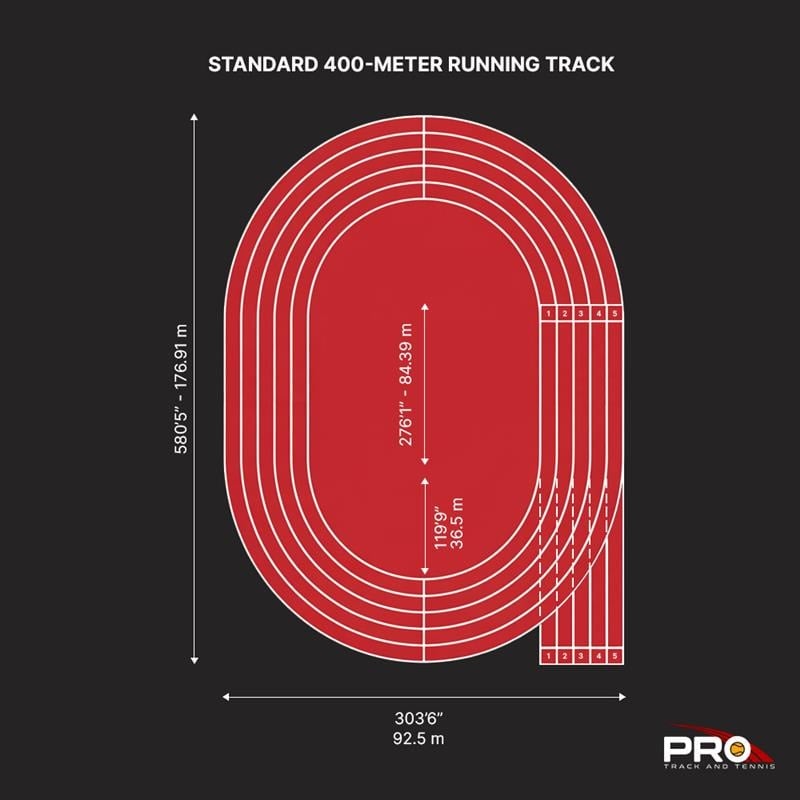
The internationally recognized outdoor track measures 400 meters in Lane 1. This standard, defined by World Athletics (formerly the IAAF), ensures consistent race distances and fair competition from high schools to the Olympics.
A regulation 400-meter lap equals:
- 400.00 meters
- 1,312.34 feet
- 0.2485 miles (just under a quarter mile)
Coaches rely on this exact geometry for interval training, pacing, and split-time analysis. Every competitive event, from the 100m to the 10,000m , is standardized to this layout, which is why most schools and municipalities choose the 400m oval when space allows.
Why Four Laps Is Not a Mile
A true mile measures 1,609.344 meters, which is slightly longer than four standard laps.
- Four laps = 1,600m
- Four laps is not equivalent to a mile; it is 9.344 meters short.
To run an exact mile, athletes must complete 4 laps + 9.344 meters. Many tracks mark this point to support accurate training for events measured in miles.
How Many Lanes Are on a Track?
Most regulation tracks have 8 lanes, though some high schools operate with 6 lanes and some elite facilities use 9. Lane count influences both competition format and daily traffic flow.
- 6 lanes: Adequate for practice but limiting for hosting meets
- 8 lanes: Most common competition standard
- 9 lanes: Used in some international venues
Lane width is universally standardized at 1.22 meters (approximately 4 feet), ensuring athletes have enough space to run safely without clustering.
For facility managers, lane count impacts construction cost, resurfacing cost, and long-term wear patterns. More lanes extend the overall width of the track, increasing materials and drainage requirements, but they also spread athlete usage across a larger area, reducing concentrated wear in Lane 1.
Lane-by-Lane Distances: Why Outer Lanes Are Longer
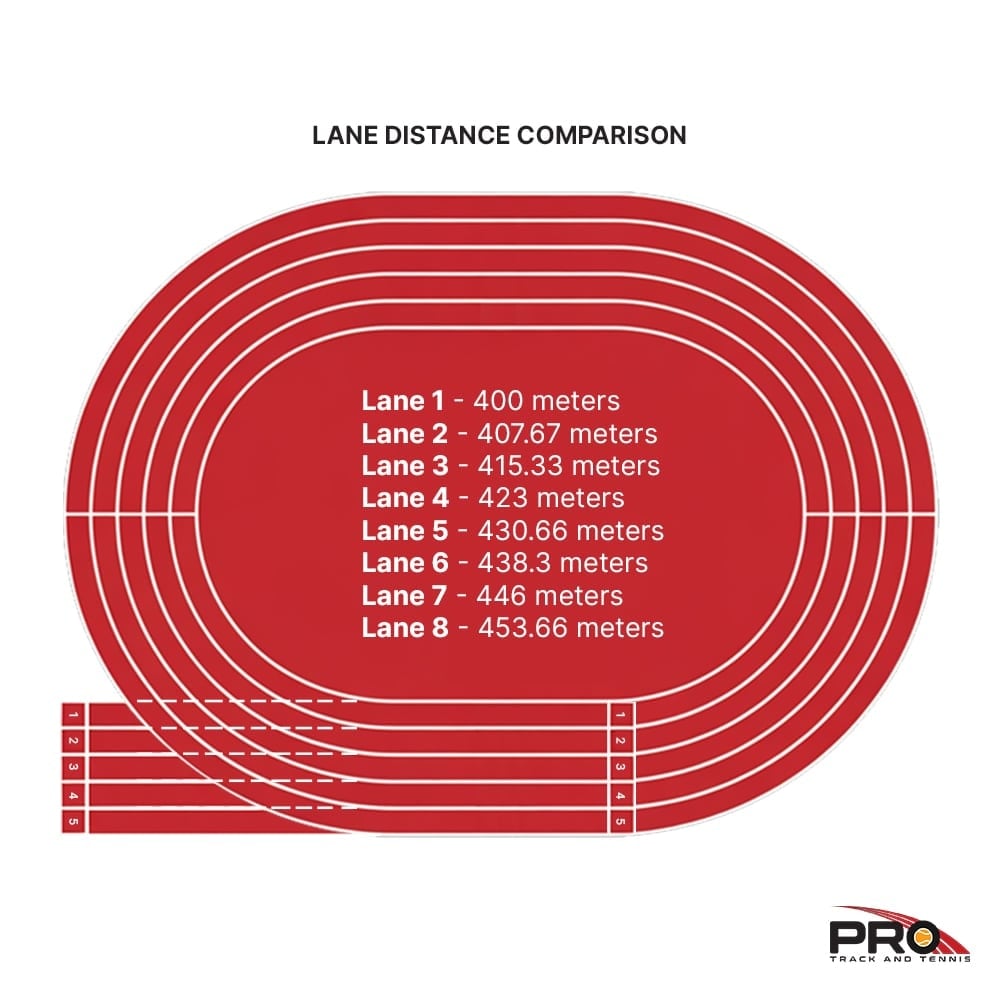
Because tracks are oval-shaped, each lane farther from the center covers a larger radius. Lane 1 always measures 400 meters, but distance increases with each lane outward.
Lane distances on a standard 8-lane track:
|
Lane |
Distance per Lap |
|---|---|
|
Lane 1 |
400.00 m |
|
Lane 2 |
407.67 m |
|
Lane 3 |
415.33 m |
|
Lane 4 |
423.00 m |
|
Lane 5 |
430.66 m |
|
Lane 6 |
438.33 m |
|
Lane 7 |
446.00 m |
|
Lane 8 |
453.66 m |
Lane 8 can be more than 53 meters longer per lap than Lane 1, a difference of over 200 meters across four laps.
This matters for facility managers because:
- Coaches often rotate training lanes to reduce wear.
- Runners training in outer lanes unknowingly cover extra distance unless marked.
- Resurfacing cycles may be accelerated if one lane absorbs disproportionate foot traffic.
Why Staggered Starts Exist
Sprint and relay races use staggered starting lines so every athlete covers the same total distance despite lane radius differences. Distance races typically allow athletes to “break” into Lane 1 after the first turn, eliminating the need for extended staggered starts.
Variations in Track Length: Indoor Tracks, 300m Tracks, and Sprint Tracks
Not every facility has room for a full 400m oval. Schools in tight urban spaces, multipurpose indoor arenas, and community facilities often turn to alternative layouts.
Most indoor tracks are designed to fit within the constraints of multipurpose facilities and urban schools.
Indoor Tracks: 160m to 300m
Indoor tracks do not follow a universal standard. Their dimensions and configurations vary depending on the available space and the intended use of the facility. Common configurations include:
- 200m: Most common collegiate size (8 laps per mile)
- 300m: Larger indoor venues; ~5.33 laps per mile
- 160m–180m: Compact spaces with tight turns
Indoor track design challenges include:
- Sharper curves
- Shorter straightaways
- Banking to offset turn radius
- Limited lane count
Pacing, stride length, and race strategy all change on these surfaces, a critical consideration for coaches.
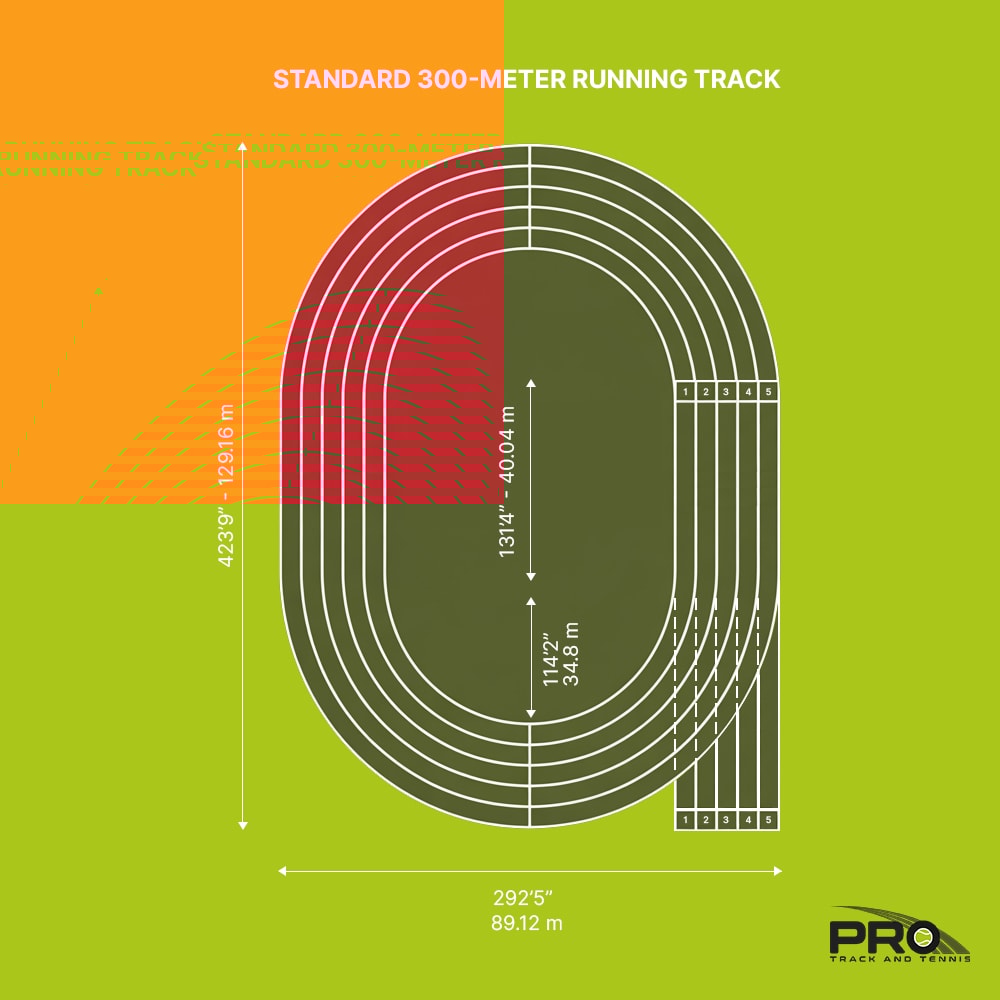
300-Meter Outdoor Tracks
Many schools adopt 300m tracks when space is limited. The decision to install a 300m track is often decided by the available land and the program’s requirements. These tracks:
- Require 5.33 laps per mile
- Are more cost-effective
- Require ~20% less land than a 400m track
- Still support sprints, relays, and conditioning
For programs that do not host official meets, a 300m track offers nearly all the functionality of a full oval while reducing land and construction constraints.
Straight Sprint Tracks
When speed development is the priority, some facilities install straight-line sprint tracks:
- 100m
- 150m
- 200m
They require minimal space, cost far less than full ovals, and are ideal for year-round sprint training.
The process of planning and installing a straight sprint track involves assessing available space, determining intended usage, and coordinating with professionals to ensure proper layout and cost estimation.
Planning a running track project? Get a free assessment →
Why the 400m Standard Became Universal
Before global metric adoption, tracks varied widely in length, from 440-yard “quarter-mile” tracks to custom ovals built around available land.
The 400-meter standard was developed to unify track measurements and facilitate international competition.
The shift to a 400-meter standard created:
- Simplified race distances
- Universal recordkeeping
- Standardized relay and hurdle placements
- Consistency for coaches and athletes worldwide
Today, World Athletics, the NCAA, and most state federations require 400m tracks for sanctioned competition, making this layout the benchmark for facility planning.
Track Measurements in Training and Competition
Why Accurate Measurement Matters in Training
Coaches depend on precision when designing workouts. Distances influence:
- Interval splits
- Repeat consistency
- Tempo pacing
- Race-simulation sessions
Athletes often use a watch to monitor splits and pacing during interval training, allowing them to track their performance without constantly checking other devices.
If athletes unknowingly train in lanes that add 20–50 extra meters per rep, pacing and performance benchmarks can drift significantly.
Many facilities paint additional markers,for 150m, 300m, or true-mile finishes to support flexible, accurate training.
Competition Requirements
Competition tracks must meet strict measurement standards:
- Curve radius
- Straightaway length
- Lane width
- Stagger calibration
- Relay exchange zone markings
Note: All measurements must be certified for official competition.
Even minor deviations can invalidate race results.
GPS Limitations on Tracks
GPS watches commonly underreport or overreport track distance due to:
- Tight curves
- Repeated small loops
- Interference from nearby buildings
Manual lap counting remains the most accurate method for distance tracking.
Track Construction, Layout, and Space Requirements
Building a track is a major long-term infrastructure decision. Geometry, drainage, and available land will influence performance, lifespan, and resurfacing cycles for decades.
How Much Space Does a Track Require?
A standard 8-lane, 400m track needs approximately 4.5 acres, including:
- Safety zones
- Field event areas
- Bleachers
- Drainage systems
A 300m track generally requires around 3.6 acres, often making it the preferred choice for land-limited campuses.
Most tracks are constructed around football or soccer fields, maximizing multi-sport efficiency.
Engineering and Performance Considerations
Track performance and longevity depend heavily on:
- Accurate curve geometry
- Proper slope for drainage
- Base compaction and stability
- Surface thickness and material selection
Field experience confirms that surface failures (cracking, bubbling, shifting) often originate from deeper issues:
- Unstable sub-base
- Poor drainage
- Inconsistent slope
A well-built base can last 25+ years. A poorly built one may fail in five. Before resurfacing an aging track, it’s important to evaluate the underlying base and drainage system, since these issues often determine whether running track resurfacing services will provide a long-lasting solution.
Cost Implications
Construction cost is influenced by:
- Lane count
- Total footprint
- Drainage infrastructure
- Sub-base preparation
- Surface material selection
- Total length of the track, as greater total length increases both initial construction and future resurfacing costs
Because resurfacing is required every 8–12 years, lifecycle budgeting is essential for long-term facility sustainability. Planning ahead for scheduled maintenance helps facility owners avoid emergency repairs and maximize the return on their investment in track resurfacing solutions.

Essential Amenities for Modern Running Tracks
Modern running tracks are more than just ovals for athletes, they’re multi-use facilities designed to support a wide range of activities, from daily track workouts to large-scale competitions. When planning or upgrading a track, it’s essential to consider amenities that maximize usability, safety, and accessibility for everyone who uses the space.
Planning a running track project? Get a free assessment →
Track Rules, Etiquette, and Maintenance Awareness
Most facilities post simple guidelines to protect the surface and manage traffic. Clear signage and posted rules help avoid confusion among track users. Common policies include:
- Walkers stay out of Lane 1
- Faster runners use inside lanes
- Teams rotate start points to distribute wear
- No stopping or standing on the track
- No vehicles on the surface unless properly protected
These practices minimize premature wear and extend resurfacing cycles.
Measuring Progress: Laps, Miles, and Lane Distances
Accurate distance tracking is key for athletes and coaches.
On a 400m track:
- 4 laps = 1,600m
- True mile = 1,609.344m (4 laps + 9.344m)
To determine how many miles you have run, divide the total meters completed by 1,609.344, or remember that four laps is just under one mile.
Many facilities mark the exact mile finish point to simplify pacing.
Because outer lanes add distance, some programs paint markers to help athletes track correct splits regardless of which lane they use.
Frequently Asked Questions
How many laps equal one mile?
Four laps equal 1,600m. A full mile requires 4 laps + 9.344 meters.
How many lanes are on a standard track?
Most competitive tracks have 8 lanes, though 6 and 9 are also common.
Are all outdoor tracks 400 meters?
No. Many schools use 300m tracks due to land limitations.
Why are outer lanes longer?
The oval geometry increases the radius of each lane outward, adding measurable distance.
Do indoor tracks follow the 400m standard?
No. Indoor tracks range widely from 160m to 300m per lap.
Bottom Line: Choosing the Right Track Size for Your Facility
Your track layout should align with your facility’s goals, space, and long-term budget.
- 400-meter tracks deliver maximum versatility, support sanctioned competition, and provide universal training accuracy.
- 300-meter tracks conserve space and cost while still supporting year-round training for most programs.
- 100–200m sprint tracks solve land-constraint problems and deliver high value for speed-focused programs.
The track you choose influences:
- Construction cost
- Resurfacing cycles
- Drainage requirements
- Athlete training quality
- Daily usability across sports
A well-planned layout ensures safer training, longer lifespan, and better return on investment.

Get a Professional Track Layout Assessment
If you’re planning a new facility or evaluating an aging surface, a professional assessment provides clarity on:
- Accurate measurements
- Base and drainage conditions
- Site-specific design options
- Understanding where the track is located, which is crucial for planning assessments and upgrades
- Cost planning
- Surface selection
A properly engineered track avoids common failures, optimizes resurfacing cycles, and supports every athlete who uses it from community runners to varsity programs.