


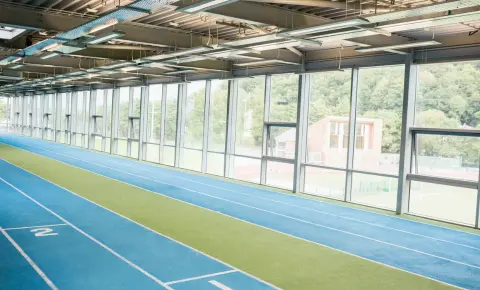
Most indoor competition tracks measure 200 meters in Lane 1, which is half the length of a standard outdoor track. That’s not arbitrary. It’s the distance that fits inside most athletic buildings while still allowing for sanctioned competition under NCAA and World Athletics standards.
But here’s what matters more practically: indoor tracks are harder to get right than outdoor tracks, mostly because the building is working against you from the start. Tighter curves, structural floors that weren’t designed with a track in mind, moisture from HVAC systems, and banking requirements all create design decisions that compound quickly. Problems you encounter years later, whether that’s surface delamination, measurement errors, or ineligibility for the competitions you want to host, usually trace back to compromises made early.
This guide explains how indoor track dimensions, construction standards, and lifecycle planning connect to real budget and facility decisions. If you’re evaluating a new build or trying to understand what you’re working with in an existing facility, the details here should help you ask better questions before money gets committed.

The 200-Meter Standard and Why It Matters
The 200-meter indoor track became the accepted standard because it threads the needle between building footprint and competition viability. Most fieldhouses can accommodate it. It produces manageable curve radii for runners. And it maps cleanly onto standard race distances, with 8 laps covering 1,600 meters (just short of a mile) and 4 laps covering 800 meters.
Non-standard tracks of 150 to 180 meters do exist, mostly at smaller schools and training facilities. They work fine for practice, but they cannot host sanctioned meets or support official records. If your program hosts competitions or expects to, the 200-meter standard is the only defensible choice.
|
Track Type |
Standard Length |
|
|---|---|---|
|
Outdoor competition track |
400 meters |
|
|
Indoor competition track (standard) |
200 meters |
|
|
Small indoor training tracks |
150-180 meters |
|
|
|
|
|

Lane Width, Count, and Curve Radius
Lane Width
Competition indoor tracks typically use lane widths of about 1.22 meters, consistent with outdoor standards. Older or more space-restricted facilities sometimes narrow to 0.9-1.0 meters, which creates real safety problems at race speeds. Tighter lanes mean less room for error when athletes are running at full effort through a tight curve. If you’re evaluating an existing facility or designing a new one, wider lanes are always the right call where building dimensions allow it.
Lane Count
Most indoor tracks run 4 to 8 lanes depending on building size and intended use. Six lanes is the most common configuration for high school facilities because it balances construction cost with enough capacity to run heats efficiently. Eight lanes make sense for collegiate and championship venues, but they require a significantly larger building footprint.
|
Configuration |
Typical Use |
|---|---|
|
4 lanes |
Small practice facilities |
|
6 lanes |
Most high school programs |
|
8 lanes |
Collegiate or championship venues |
If you’re building new and aren’t sure how many lanes to specify, six is the defensible default for most programs. Fewer than six limits your ability to host larger meets and forces more heats. More than six requires building space and budget that most high school facilities don’t have.
Curve Radius and Why the Geometry Is Demanding
This is where indoor tracks diverge most sharply from outdoor ones. A standard indoor 200-meter track has a curve radius of roughly 17 meters. Outdoor tracks run closer to 36-37 meters. That difference isn’t just a number. Tighter curves put more lateral force on runners, create more joint stress, and change racing strategy. It’s also why banking matters so much more indoors than out.
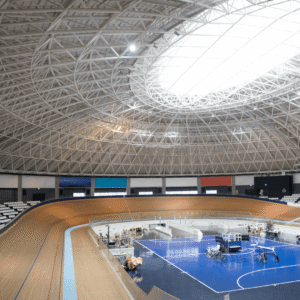
World Athletics specifications call for banking angles of approximately 10 degrees on the curves of a 200-meter indoor track. Facilities that don’t bank the curves are making a cost-driven tradeoff that shows up in athlete performance and joint stress on every lap.
Banked vs. Flat: An Honest Comparison
A banked track tilts the outer edge of the curve upward to counteract the centrifugal force runners generate at race speed. The physics are straightforward. At the tight curve radii required indoors, athletes on flat tracks are fighting lateral force with every stride through the turn. Banking eliminates most of that.
Banked tracks are standard in collegiate and professional venues where racing speed is the primary consideration. They’re also more expensive to build and require more structural engineering to support the banking structure itself.
Flat tracks are more common at the high school level, and for good reason. If the building can’t accommodate banking structures, if the facility serves multiple sports, or if the construction budget is constrained, flat is often the practical choice. Flat tracks work well for training and smaller competitions. The tradeoffs are real but manageable: curve speeds are slower, joint stress is higher, and eligibility for high-level sanctioned meets may be limited depending on the governing body and event.
If you’re planning a new indoor facility and expect to host regional or state-level competition, it’s worth understanding specifically which governing body standards apply and whether flat or banked affects your eligibility before the structural design is finalized.

Governing Standards You Should Know
The most important practical question isn’t whether your track meets general standards. It’s whether your track meets the specific standards for the competitions you want to host. Those are different questions.
World Athletics governs international and record-eligible competition. Key requirements include the 200-meter track length, a curve radius of approximately 17.2 meters, lane widths around 1.22 meters, banking on curves for championship facilities, and surface performance testing. If your facility doesn’t meet these specs, it’s ineligible for international competition and certain record attempts.
NCAA indoor standards closely mirror World Athletics guidelines. Most NCAA championship venues feature 200-meter banked tracks with six to eight lanes and polyurethane competition surfaces. Schools operating smaller or flat tracks often face restrictions on what competitions they can host. This is worth understanding early if your program has conference hosting aspirations.
High school standards vary more widely. Many state associations follow NFHS guidelines, which are generally less restrictive than NCAA or World Athletics requirements. This is part of why you see significant variation in high school indoor facilities, from full 200-meter banked tracks to small flat practice ovals.
The practical implication: if there’s any chance your facility will be used for sanctioned competition, verify the specific standards that apply before locking in design decisions. It’s a much easier conversation before the structural slab is poured.
Measurement, Stagger Lines, and Why They Matter
Indoor track distance is measured along a reference line positioned 30 centimeters from the inner kerb when a kerb is present, or 20 centimeters from the inner boundary when there’s no kerb. This line represents the typical running path in Lane 1 and is the baseline from which all stagger calculations flow.
Outer lanes travel a longer distance around each curve, so staggered start lines are used to ensure every runner covers the same total distance. These staggers have to match the track’s actual geometry precisely. An error in the measurement line or in stagger placement doesn’t show up as a visual flaw. It shows up as a disqualified race result or a rejected records application.
|
Lane |
Approximate Stagger (200m race) |
|---|---|
|
Lane 1 |
0 m |
|
Lane 2 |
~5.6 m |
|
Lane 3 |
~11.8 m |
|
Lane 4 |
~18.0 m |
|
Lane 5 |
~24.3 m |
|
Lane 6 |
~30.5 m |
These calculations are typically verified during track certification. If you’re resurfacing or repainting an existing track, make sure the contractor can confirm the measurement lines against the actual geometry rather than just repainting what’s already there. Errors compound.
Indoor Track Construction: What’s Different
The Building Is a Constraint, Not Just a Container
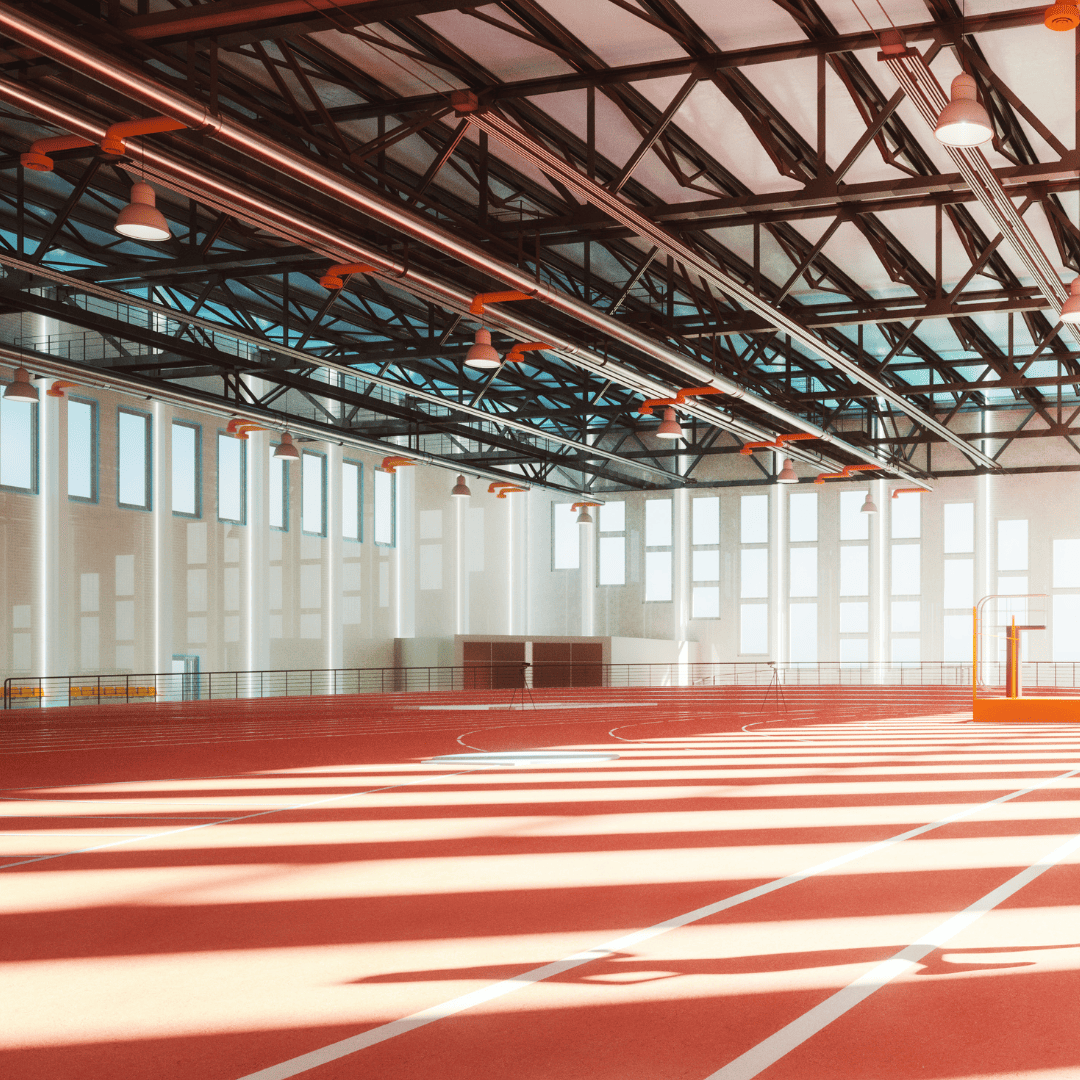
Retrofitting a track into an existing building is one of the most common sources of design compromise in indoor track facilities. If structural capacity or ceiling height is limited, if the floor wasn’t designed to support banking loads, or if HVAC placement dictates curve positioning, every one of those constraints becomes a permanent tradeoff. Planning the track early in the architectural design process, before structural and mechanical decisions are locked, is the single most important thing you can do to avoid problems that can’t be fixed later.
Base and Subsurface Layers
Indoor tracks are built on reinforced concrete slabs, but proper base preparation matters even when you’re working inside a building. Typical construction layers run from the structural slab through leveling layers, vapor barriers, and the synthetic track surface system. If these layers aren’t installed correctly, the surface will tell you about it through bubbling, delamination, and uneven wear in the lanes.
Moisture Control
This surprises some facility managers: moisture is still a significant issue indoors. Ground vapor migrates through concrete. HVAC systems add humidity. Temperature differences create condensation. Building leaks happen. Vapor barriers and moisture testing before surface installation aren’t optional on a well-built indoor track. If they’re skipped to save time or money, the surface system pays for it through shortened lifespan and adhesion failures.
Surface Systems and Realistic Lifespan Expectations
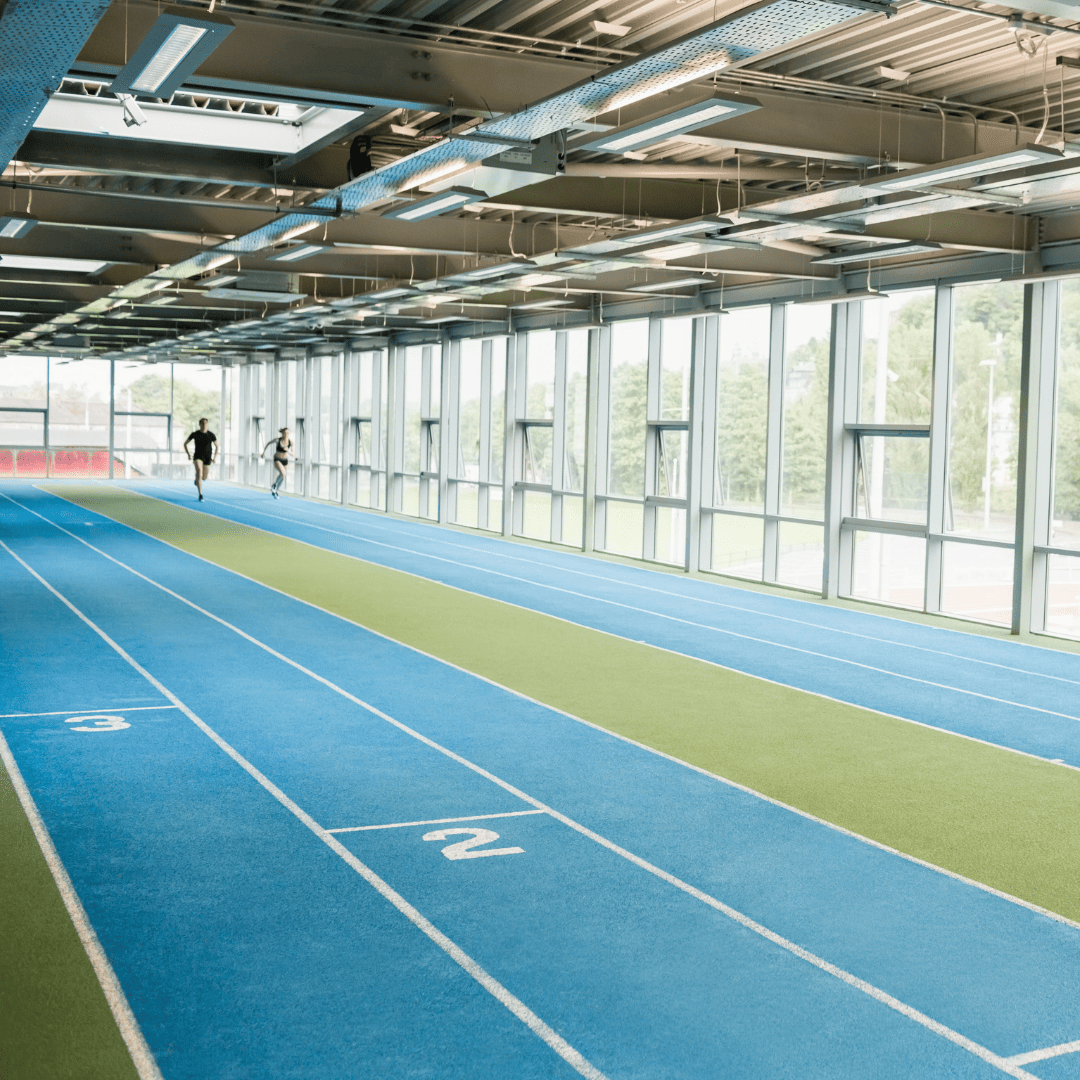
Most indoor competition tracks use polyurethane surface systems, which provide consistent traction, good energy return, and durability under heavy use. Indoor surfaces last longer than outdoor surfaces because they’re protected from UV exposure, freeze-thaw cycles, and weather. But lifespan varies meaningfully based on usage volume, maintenance consistency, and climate control in the building.
Prefabricated modular track systems are also used in arenas where the track needs to be temporary or where the facility converts between sports uses. The precision of off-site manufacturing is an advantage, but seams between sections require ongoing attention to prevent moisture intrusion and surface wear.
Regardless of surface type, routine maintenance extends the usable life significantly: regular sweeping, inspecting seams and edges for early cracking, repairing minor damage before it spreads, and protecting high-traffic areas like curves and start zones. Indoor tracks that receive consistent maintenance behave predictably. Indoor tracks that don’t tend to surprise facility managers at the worst possible time.
Common Design and Construction Mistakes
Most indoor track problems originate during planning, not during use. The mistakes that show up later look like surface failures or measurement errors, but they’re usually decisions made years earlier. The most common ones:
- Curve radii too tight for the building footprint, with no room for banking
- Lane widths set too narrow to meet competition standards
- Structural floors not engineered to handle banking loads
- Moisture control skipped or deferred during base preparation
- Measurement lines and stagger markings not verified against actual geometry
What these mistakes share is that they’re very expensive to correct after the fact. A tight curve radius can’t be widened once the facility is built. A structural floor that wasn’t designed for banking can’t easily be upgraded. Getting professional input during the design phase, before structural and mechanical decisions are made, is far cheaper than working around the consequences of those decisions for the next 20 years.
Budget Planning for Indoor Track Projects
Indoor track construction involves considerably more than installing a running surface. The surface system is often the smallest line item once you account for structural building integration, base preparation, vapor barriers, banking structures, lighting, and timing systems. This is one of the reasons early planning pays off: a track that’s incorporated into the building’s structural and mechanical design from the start costs less and performs better than one that’s retrofitted into a building designed for other purposes.
For ongoing budget planning, the categories to account for are regular maintenance (cleaning, minor repairs, seam inspection), lane marking repainting every few years, and eventual resurfacing when the surface system reaches the end of its useful life. Facilities that plan for these costs as recurring line items are rarely surprised. Facilities that don’t tend to encounter them as crises.
For new construction cost planning, the variables are significant enough that honest scoping requires a site evaluation. Building size, structural requirements, banking needs, and surface system choice all move the number. Any contractor who quotes a firm number without that information is guessing.
Not Sure What Your Existing Indoor Track Needs?
Pro Track & Tennis has completed more than 1,000 track and court projects across 25+ states. We can evaluate your surface condition, measurement accuracy, and help you understand your resurfacing options, giving you a clear picture of what you’re working with.
We’re an ASBA member with in-house crews, which means no subcontractors and no surprises.
Call 402-761-1788 or email info@protrackandtennis.com to schedule a site evaluation.

Frequently Asked Questions
How long is an indoor running track?
Most competition indoor tracks measure 200 meters in Lane 1, half the length of a standard outdoor 400-meter track.
How many laps equal a mile on a 200-meter indoor track?
A mile is 1,609.34 meters, which works out to just over 8 laps. Most races use 1,600 meters (exactly 8 laps) for practicality.
Are all indoor tracks 200 meters?
No. Some facilities use 150- to 180-meter tracks, which work for training but generally can’t host sanctioned meets or produce official records. If competition eligibility matters for your program, 200 meters is the right specification.
Why are indoor tracks banked?
Banking counteracts the lateral force runners experience on tight indoor curves. At the curve radii required for a 200-meter indoor track, unbanked curves create more joint stress and slower race speeds. World Athletics specifications call for approximately 10 degrees of banking at championship venues.
How much does an indoor track cost?
The honest answer is that it depends heavily on building integration, structural requirements, banking, and surface system choice. The surface system itself is often not the dominant cost in a new indoor build. A proper estimate requires a site evaluation. What we can say is that the cost of designing it right up front is consistently lower than the cost of correcting design compromises later.
Can high schools build indoor tracks?
Yes. Many high schools build flat indoor tracks with fewer lanes because of space and cost constraints. These facilities work well for practice and smaller competitions. If your program plans to host sanctioned meets, verify the specific governing body standards that apply before finalizing the design.
The Bottom Line
Indoor track design rewards careful planning and penalizes shortcuts. The decisions made before a shovel goes in the ground, about curve geometry, banking, structural support, moisture control, and measurement, determine what the facility can do for the next 20 years.
Facility managers who engage a qualified track specialist early in the process, before architectural and structural decisions are locked, consistently end up with better facilities at lower total cost. Those who don’t tend to discover the tradeoffs one at a time, usually at inconvenient moments.
If you’re planning a new indoor facility or evaluating an existing one, we’re happy to help you understand what you’re working with.
Call 402-761-1788 or email info@protrackandtennis.com. Pro Track & Tennis serves facilities across 25+ states with in-house crews and ASBA membership.