The short answer: Running track certification in the US follows a five-class system developed by the American Sports Builders Association (ASBA). Class 1 and 2 apply to international competition and require World Athletics documentation. Classes 3, 4, and 5 cover national collegiate, state high school, and general accuracy standards. Most high school and university tracks fall into Class 3, 4, or 5. Expiration depends on the class: the higher classes (1, 2, and 3) carry a multi-year validity, while Class 4 and 5 do not run on a clock and are re-certified whenever the track is restriped or resurfaced. Either way, any resurfacing or restriping triggers a new round of running track certification requirements.
Most athletic directors raise certification after they’ve already started talking to running track resurfacing contractors.
That’s backwards. The class you need determines the surface system you specify. The surface system sets the budget. Getting that sequence wrong costs money and sometimes kills the certification goal entirely.
This article covers what each certification class requires, when World Athletics standards apply, what triggers recertification, and how to plan a resurfacing project with certification built into the scope from the start.

What “Certification” Actually Means for a Running Track
Certification documents that a track meets defined accuracy and performance standards. It is not a safety inspection, and it is not a product guarantee. Contractors install surfaces. Surveyors certify tracks. Those are different jobs, and conflating them is how projects miss their competition deadlines.
Two separate systems operate in the US. The ASBA system covers domestic competition from high school meets through national collegiate events. The World Athletics system (still widely called IAAF certification) applies specifically to facilities hosting international competition or meets where foreign athletes participate. Most tracks in the US only ever need ASBA certification. If your facility does not host international competition, the World Athletics section below is background context, not a planning requirement.
The Five ASBA Certification Classes Explained
The ASBA defines five certification classes, each calibrated to a different competition level:
| Class | Primary Use |
| Class 1 | International championship or cup meets |
| Class 2 | Other international meets, or meets with foreign athlete participation |
| Class 3 | National collegiate meets where NCAA records may be set |
| Class 4 | State or national high school meets where records may be set |
| Class 5 | General accuracy assurance |
Classes 4 and 5 cover most high school tracks in the US. A Class 4 certification requires a signed ASBA form, verified computer-generated calculations, lane radius measurements at 26 designated curve locations in lane one, and course length measured with a temperature-corrected steel chain and theodolite on curves. (Class 5, the lightest level, drops to 12 random radius locations.) In situ surface testing is not required at Class 3, 4, or 5. That matters for budgeting, because in situ testing adds a separate cost and scheduling requirement.
Class 3 raises the bar. It requires the ASBA Class 3 Certification Form, verified computer-generated calculations, slope certification for both the event areas and the track, and radius measurements at 26 designated locations in the curves (lane one). It does not require in situ surface testing; that applies only to Class 1 and 2. Class 3 is the right target if your facility hosts NCAA championship qualifiers or expects national collegiate records to be set.
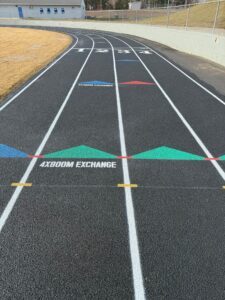
Classes 1 and 2 require the full IAAF measurement package plus a World Athletics product certificate for the installed surface. The surface system itself must carry that pre-approval before your facility can pursue Class 1 or 2 certification. Not every polyurethane track system on the market holds it.
Lane width tolerances tighten as the class rises. At Class 5, the tolerance is design lane width plus or minus 0.03 meters. At Class 1 and 2, it drops to plus or minus 0.01 meters. A one-centimeter difference in tolerance doesn’t sound like much, but across a standard 400-meter track covering 45,000 square feet, a stripe that drifts two centimeters off-line shows up to the naked eye and flags on the measurement survey.
Expiration works differently by class. Class 1, 2, and 3 certifications carry a time-based validity (World Athletics facility certificates currently run five years and are extendable; ASBA lists four years for Class 3). Class 4 and 5 do not expire on a clock; they are re-certified when the track is restriped or resurfaced. Either way, any restriping or resurfacing forces recertification, so budget it as a line item in any track project, not as an afterthought when the contractor is already off site.
World Athletics (Formerly IAAF) Certification: When It Applies
Why does the surface product need its own World Athletics certificate? Because the certification framework was built around ensuring that any surface used for international competition meets minimum performance thresholds before a single measurement is taken. Facility accuracy doesn’t matter if the surface itself is out of spec.
For Class 1, World Athletics verification extends beyond the surface to the structural conditions of the complete stadium. Very few US facilities operate at that level. For a high school, a community college, or most Division II and III programs, Class 1 is not the relevant standard.
For Division I programs that regularly host international athletes in multi-sport invitational meets, Class 2 deserves a closer look. The measurement tolerances at Class 1 and 2 are the tightest in the system, course length tolerance sits at 0.0002 times the course length (positive only), and both lateral and longitudinal slopes are regulated at standards that require EDM equipment over 20 meters with a theodolite for curves. A World Athletics-accredited surveyor handles the measurement. Plan for more documentation and longer timelines than a Class 3 or 4 project.
What Triggers Recertification
Here’s where most facilities get caught off guard.
Two things trigger it. For Class 1, 2, and 3, the certificate expires on its own timeline (World Athletics facility certificates run five years; ASBA lists four years for Class 3). And at any class, a change that affects dimensional accuracy or surface performance forces recertification. Restriping resets it. Resurfacing resets it. A full scrape and new mat installation absolutely resets it.
This is a planning problem as much as a compliance one. If your certification lapses in 2027 and a structural spray is on the calendar for 2026, the recertification process needs to be scoped into the project from the beginning. Resurfacing and certification are two separate engagements: the resurfacing contractor installs the surface, and a qualified surveyor handles the measurement survey, slope documentation, and submission. You need to coordinate both, not assume one leads automatically to the other.
Scheduling matters here. Measurement cannot begin until the surface has fully cured. Then the survey, slope check, in situ testing (if required for your class), and documentation all run in sequence. For most Class 3 and Class 4 projects, that process runs in parallel with the final two to four weeks of project wrap-up. For Class 1 and 2 work, allow more time. The World Athletics documentation requirements are more involved, and accredited surveyors are not always available on short notice.
How Surface Condition Affects Certification Eligibility
A track in poor surface condition can fail the dimensional and performance requirements for the class it’s targeting. This is the connection that most certification articles skip entirely, and it’s the one that bites facilities the hardest.
Consider what the certifying survey actually checks. The track’s markings and slopes have to hold to tight tolerances, and the surface underneath has to be sound enough to keep them there. A track with delamination, severe cracking, or significant birdbaths may not hold stripes to Class 3 lane width tolerances. Low spots that hold water and a crumbling base pull the lane marks out of position. A track that looks usable from the sideline can still fail the measurement pass when the lane marks can’t hold to the required precision over a deteriorated base.
The surface condition question and the certification question are the same question. Does that mean every deteriorated track needs a full rebuild before it can certify? Not necessarily.
“A running track can be pretty wore out, but you can patch it, you can patch the cracks, and you can do what they call a structural spray. It’s like repainting your house. You’re repainting it, but you’re adding rubber to the paint coating.”
Lance Laurent, President, Pro Track & Tennis
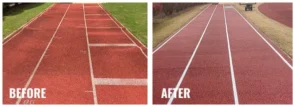
That framing matters for certification planning. A structural spray can restore a deteriorated track to a condition where it holds accurate stripes and slopes at Class 3 or Class 4. A full scrape and new mat is not always required to get there. Which approach is viable depends on the base condition underneath, and that’s exactly what a written assessment is designed to determine before any resurfacing contract is signed.
The Certification Process Step by Step
Certification runs a defined sequence. Understanding it up front prevents scheduling conflicts and budget surprises.
Step 1: Surface completion and cure. Measurement cannot begin until the surface has fully cured. Starting the survey too early produces results that won’t hold, and the survey will need to be repeated.
Step 2: Measurement survey. A qualified surveyor measures lane widths, curve radii at the designated number of locations for the target class, and course length with the prescribed equipment.
Step 3: Slope certification. Lateral inclination toward the inside edge must not exceed 1:100. Overall downward inclination in the running direction must not exceed 1:1000. Both are verified, documented, and submitted.
Step 4: In situ surface testing (required for Class 1 and 2 only). Physical performance testing of the installed surface. Class 3, 4, and 5 skip this step.
Step 5: Documentation. Verified, computer-generated calculations prepared, signed, and submitted with the appropriate ASBA certification form or IAAF Report of Measurement.
Step 6: Certificate issued. For Class 1, 2, and 3 the validity period starts; Class 4 and 5 hold until the track is restriped or resurfaced.
Track resurfacing projects typically wrap up in two to four weeks once on-site work begins. Build the certification process on top of that for scheduling purposes. If your next conference season starts in September, work backward from that date before you sign the resurfacing contract, not after.
What Running Track Certification Costs
Look, certification costs and resurfacing costs are not the same line item.
The measurement survey and documentation work are a third-party engagement with a qualified surveyor, separate from the contractor relationship. Treat them as a distinct budget item. What that survey costs depends on the certification class, the surveyor’s travel, and the documentation requirements for Class 1 or 2 versus Class 3 through 5.
The resurfacing cost is the larger figure by a wide margin. Here’s where current projects land:
- Structural spray and restriping: approximately $120,000 for a standard 8-lane, 400-meter track (5,000 square yards / 45,000 square feet)
- Full scrape and new mat: $200,000 to $300,000
- Premium surface systems: $300,000 to $700,000
- Division I university-level projects: $700,000 to $1,000,000 and above
The surface system choice affects both the resurfacing cost and the certification class you can realistically pursue. Premium systems are more likely to carry World Athletics product certification. A structural spray with a qualified installer and proper documentation supports Class 3 and Class 4 certification. If your conference schedule requires Class 1 or 2, the surface system selection narrows considerably, and so does the contractor list.
Across 1,000+ completed projects, the facilities that budget the most effectively treat the certification class as input to the procurement process, not output. Know the class first. Price the system second.
Planning Your Track Project Around Certification Goals
The sequence matters more than most facilities recognize. Start with the class your competition schedule requires. Work backward to the surface system that satisfies those requirements. Then select an ASBA member contractor with documented experience at your target class.
So what should you confirm before signing any resurfacing contract? Does the surface system carry World Athletics product certification if Class 1 or 2 is the target? Is the contractor an ASBA member? Is the recertification survey scoped separately or bundled into the contract? Do the specified tolerances match the target class requirements?
Getting clear answers to those questions before the contract is signed is worth more than any contingency clause after the fact.
Pro Track & Tennis is an ASBA member with 30+ years of running track experience across more than 1,000 completed projects in 25+ states. Our crews are in-house on every project. We do not subcontract. For running track resurfacing scoped to meet your certification requirements, that continuity matters.

Frequently Asked Questions
How long does running track certification last?
It depends on the class. Class 1, 2, and 3 certifications carry a multi-year validity (World Athletics facility certificates currently run five years and can be extended; ASBA lists four years for Class 3), so they expire on a timeline even if no surface work is done. Class 4 and 5 do not expire on a clock; they need re-measurement and recertification when the track is restriped or resurfaced before it can host competition at the certified class level.
Does resurfacing automatically recertify my track?
No. Resurfacing triggers the recertification requirement but does not complete it. The surface must be installed, cured, surveyed, slope-certified, and documented before a new certificate is issued. Those are separate engagements from the resurfacing contract itself.
What certification class does a high school track need?
Most high school tracks target Class 4 or Class 5. Class 4 is appropriate if the facility hosts meets where state or national high school records may be set. Class 5 covers general accuracy assurance for facilities that do not host record-eligible competition. Class 3 comes into play for NCAA qualifier events.
Can a damaged track still get certified?
It depends on the condition. Severe surface deterioration can cause a track to fail in situ testing or miss lane width tolerances or fail to hold accurate markings at the target class. In many cases, a structural spray project restores the surface to a certifiable condition. A written assessment determines which resurfacing path gets you there.
Who is qualified to certify a running track?
ASBA certification requires a qualified surveyor with equipment appropriate for the target class. Class 1 and 2 certification requires World Athletics-accredited measurement personnel. The certifying surveyor is always a separate engagement from the resurfacing contractor. Both need to be on the project plan before construction begins.
Does restriping alone trigger recertification?
Yes. Restriping alters the dimensional markings on the track, which resets the existing certification. Any facility that restripes should treat recertification as part of the project scope.
Build Certification Into Your Running Track Resurfacing Plan
Running track certification requirements follow a clear sequence, but most facilities get tripped up by planning the surface project first and the certification second. Know the class your competition schedule demands. Specify a compatible surface system. Coordinate the measurement survey before the resurfacing contract is signed.
If you’re not sure which certification class fits your facility, or you want a professional assessment of your track’s current surface condition and certification eligibility, Pro Track & Tennis offers written track assessments. Call 800-498-4395 or email info@protrackandtennis.com to schedule one.