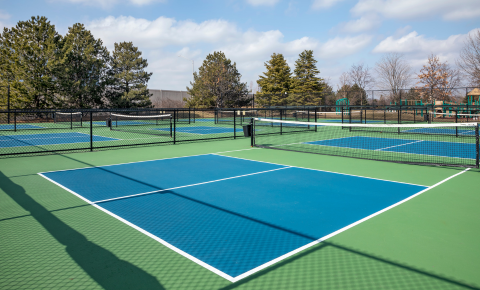
Hosting TYPTI at your club takes three things: a pickleball court in sound condition, a small equipment order for rackets and balls, and a programming plan built around open play, ladder leagues, and beginner clinics. No new construction. Most clubs can go live inside a week.
That’s the short version. The longer version covers what to buy, what it costs, how two real clubs are running it, and where the money actually comes from.
TYPTI launched in January 2026 at California Smash, an indoor pickleball and social club in El Segundo, California. It runs on a standard 20-by-44-foot pickleball court, using a strung racket and a foam ball instead of a paddle and a plastic ball. For an owner sitting on pickleball courts already, that’s the whole appeal. The infrastructure question is already answered. What’s left is equipment, programming, and math.
This guide walks through all three, plus where Pro Track & Tennis fits if your courts need work before you add TYPTI to the schedule.
Equipment: What You’re Actually Buying
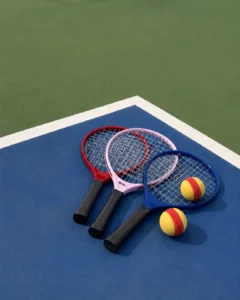
TYPTI equipment is simple compared to building out a new sport from scratch. Players use a 22-inch strung racket, roughly the shape of a paddle-tennis frame but strung like a small tennis racket, and a 3.5-inch channeled foam ball. Rackets run roughly $100 to $150 depending on model. Balls run several dollars apiece, and they wear out faster than a solid-core pickleball. Budget for balls as a recurring line item, not a one-time purchase.
For sourcing, Tennis Warehouse and Pickleball Warehouse both stock TYPTI gear under dedicated storefronts, alongside the manufacturer’s own retail channel. For a club, that means volume ordering through a supplier you may already use for pickleball paddles and balls. No new vendor relationship required, just a new SKU list.
Do you need a demo inventory before committing to full racks? Most clubs order a small batch first, six to ten rackets and a case of balls, run a free demo weekend, then scale the order based on member interest. That approach costs a few hundred dollars and tells you more than any projection will.
Court Readiness Comes First
Here’s the part clubs skip and regret. TYPTI’s foam ball bounces higher and livelier than a standard pickleball, which means it reads surface imperfections a pickleball simply rolls past. Cracking, birdbaths, worn acrylic, and lifting seams all show up faster in TYPTI play than they do in pickleball. A birdbath that stays wet for days after rain won’t just sit there looking bad. It’ll produce a soft, dead bounce right at the spot where a player expects a clean pop off the foam ball, and they’ll feel it the first time they step into that spot.
If you haven’t already, walk through the full court readiness checklist in our companion guide, “Can Your Pickleball Court Host TYPTI?”, before you order equipment or announce a launch date. A court that plays fine for pickleball can still produce bad bounces in TYPTI if the surface has deferred maintenance sitting underneath it. Better to catch that before you announce a launch date than after.
We’ve walked courts across 25+ states that played fine for pickleball and still needed crack repair before we’d sign off on them for a sport with a steeper ball bounce. The surface doesn’t have to be new. It has to be sound.
Programming: Open Play, Ladder Leagues, Lessons, and Demo Days
TYPTI programming maps almost directly onto pickleball programming, which is the entire point. Clubs adding it typically run four formats.
Open play slots TYPTI into existing court blocks, often during off-peak hours when courts would otherwise sit empty. This is the lowest-lift starting point. No league structure, no commitment, just a labeled block on the schedule.
Ladder leagues come next, and they’re where TYPTI-specific club software has focused. Ladder and bracket formats, including single elimination, double elimination, and round robin, run through the same booking systems many clubs already use for pickleball leagues. Members climb or fall based on results, and live brackets keep the competitive layer visible without extra staff time.
Lessons and clinics round out the model. Beginner conversion clinics teach the no-kitchen rule and the different scoring structure to pickleball players in under an hour, since the court and the general racket-sport instincts transfer. Private lessons follow the same per-hour pricing logic as pickleball instruction.
Demo days are the on-ramp for all of it. A single afternoon, a few loaner rackets, and an open invitation to current members does more to build a TYPTI base than any amount of email marketing.
What’s Working at California Smash
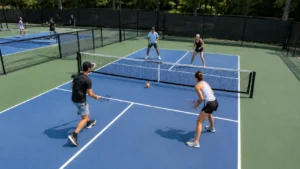
California Smash is where TYPTI actually launched, in a January 2026 event that put the sport in front of national media and a room full of pickleball players who’d never seen it. The club already ran tiered programming across beginner, intermediate, and advanced play, plus dedicated open play and youth sessions, before TYPTI arrived. That existing skill-tiered structure is exactly the format TYPTI slots into: a new sport riding on a programming architecture the club had already built for pickleball. Nothing about the court changed to make that launch possible. What changed was the schedule, the equipment order, and the invitation to members who were already walking through the door for pickleball. That’s the sequence worth copying, not the press coverage.
For other operators, the takeaway has nothing to do with hosting a launch event. TYPTI adoption goes faster at clubs that already segment players by skill level and already run structured open play. If your club has that in place, you’re most of the way to a TYPTI schedule already.
Why does existing structure matter more than enthusiasm? Because a club can get members excited about a demo day and still have nowhere to put them the following week without a real skill-tiered schedule behind it.
The Match Point Model: Scaling Without New Construction
Match Point Pickleball Club in Columbus, Ohio runs 38 indoor courts, one of the largest single-facility footprints in the country, with ladder leagues, team-based leagues, and DUPR-rated skill divisions running across morning, evening, and weekend blocks. A facility built at that scale needs no new construction to add TYPTI, just court blocks and a bracket added to a league system that’s already running.
That’s the real takeaway for mid-size and large clubs. The programming lift is small. You’re extending a ladder league framework you’ve already built for one sport to a second sport that uses the identical court footprint.
Marketing TYPTI to Members You Already Have
The clubs getting the fastest adoption market TYPTI to the members already standing on their courts, before they spend a dollar on the general public.
Why lead with current members instead of the open market? Because they already own the shoes, already know where the parking lot is, and already trust the club to introduce them to something worth their evening. For pickleball members, the pitch is variety without switching venues: same court, same shoes, a different racket and a faster-paced rally structure. For tennis members, TYPTI is often positioned as a lower-commitment entry point, a way to stay involved in a racket sport without the footwork demands or time commitment of a full tennis match. Neither group has to learn a new facility.
They just have to show up on a night the schedule says TYPTI instead of pickleball.
Practically, that means email and app notifications to existing members before any paid advertising, a demo day that doubles as a marketing event, and signage on existing courts rather than a separate build-out. Clubs that try to build a TYPTI audience from scratch, outside their existing membership base, are doing the hard version of this launch. The easy version starts with the people already walking through your door.
The Revenue Model: Court-Hours, League Fees, and Lessons
TYPTI runs on the same court, so it runs on largely the same revenue model as pickleball. That’s useful, because pickleball facility economics are well documented and TYPTI gives you no reason to expect the numbers to look fundamentally different on a per-court basis.
These figures are general pickleball-industry benchmarks, not PTT-verified figures, and they should be treated as a starting reference point, not a guarantee. Every market prices differently, and a club in a secondary market shouldn’t expect urban-market numbers.
The real advantage is simple. TYPTI fills existing court-hours with a second bookable activity at largely the same price points you already charge, with no new revenue category to build. The upside is real but modest per hour. The advantage is that it comes at close to zero marginal construction cost, since the court, the booking system, and the member base already exist.
Is there a ceiling on that upside? Some. TYPTI is early-stage, and it’s not clear yet how much incremental court-hour demand it generates versus how much it simply reshuffles existing pickleball hours into a different label. Clubs running it as a genuine addition, in off-peak slots that were previously empty, see the clearest net gain.
Where Pro Track & Tennis Fits
Everything above assumes your courts are ready.
If they’re not, the programming and marketing plan doesn’t matter yet.
“We use our own crews. Once you start subbing stuff out, you lose control.”
Lance Laurent, President, Pro Track & Tennis
That’s the operating principle behind every court Pro Track & Tennis touches, and it’s the reason facility owners bring PTT in before committing to a new sport on an existing surface. Pro Track & Tennis provides written assessments and surface work for pickleball and multi-purpose courts across 25+ states, with in-house crews on every project and no subcontracting. Across 1,000+ completed projects, the pattern holds: facilities that check surface condition before adding a new sport avoid the member complaints that show up after they don’t.
If you’re planning to add TYPTI and you’re not sure whether your courts qualify as-is, that’s exactly what a written assessment answers. Call 800-498-4395 or email info@protrackandtennis.com to schedule one.
FAQ
How much does it cost to add TYPTI to my club?
Equipment is the smallest cost. Rackets run roughly $100 to $150 each and foam balls run several dollars apiece and wear faster than pickleball balls, so budget them as a recurring cost. The larger variable is court condition. If your courts already pass a pickleball readiness check, equipment is close to your only added cost. If they need crack repair or resurfacing first, that cost depends on the scope of work.
Do I need new courts to host TYPTI?
No. TYPTI runs on a standard 20-by-44-foot pickleball court with no dimensional changes. If you already operate pickleball courts in good condition, you have TYPTI infrastructure today.
What’s the best way to introduce TYPTI to my members?
Start with a demo day using a small equipment order, market it to your existing pickleball and tennis members before any outside advertising, and slot early sessions into off-peak court hours rather than displacing existing programming.
What programming works best for a new TYPTI offering?
Open play first, since it requires no structural commitment. Ladder leagues next, once you have enough regular players to fill brackets. Beginner clinics and demo days run alongside both to keep bringing in new players.
Is the TYPTI revenue model different from pickleball?
Not structurally. Court rental, open play fees, league fees, and lesson pricing all follow pickleball benchmarks because TYPTI uses the same court and largely the same booking systems. The advantage is filling existing court-hours rather than building a new revenue category from scratch.
How do I know if my courts are ready for TYPTI?
Check for cracking, birdbaths, worn or slick acrylic, and any lifting or delamination. TYPTI’s steeper ball bounce exposes surface flaws that pickleball can mask. Our companion guide covers the full readiness checklist, and a written surface assessment settles it definitively if you’re not sure.
Pro Track & Tennis provides pickleball court surfacing and conversion, plus multi-purpose court surfacing, across 25+ states. ASBA member, in-house crews on every project. Call 800-498-4395 or email info@protrackandtennis.com.