


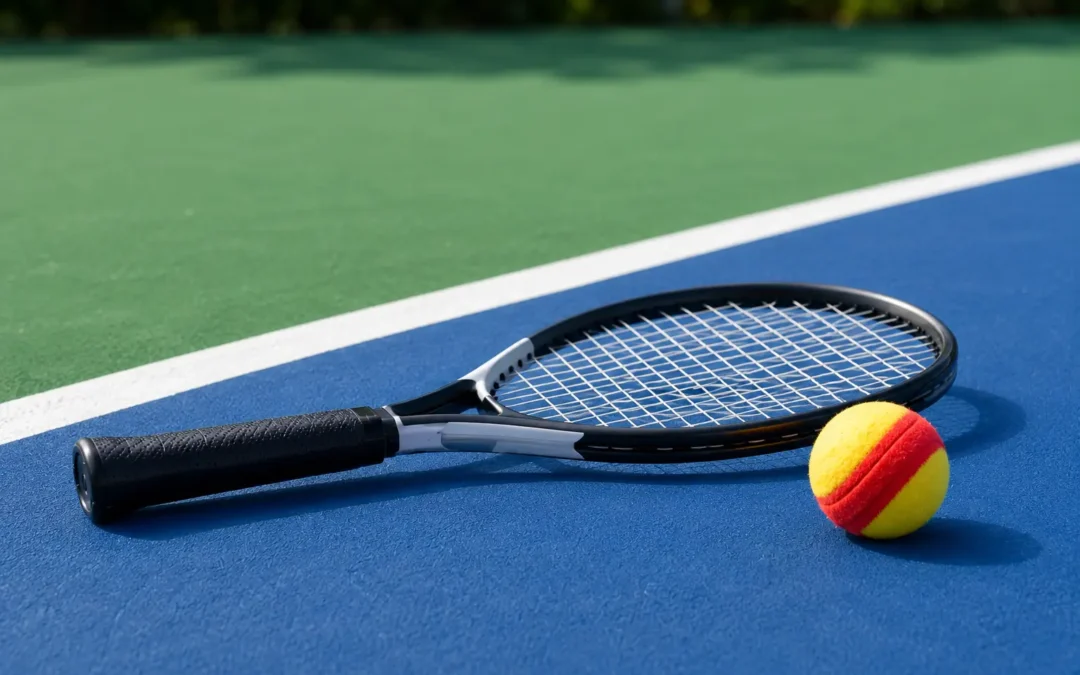
The short answer: yes. A standard 20-by-44-foot pickleball court with a sound surface can host TYPTI with no changes to its dimensions, net height, or line markings. No new lines. No net swap. No additional infrastructure.
The longer answer is about condition, not configuration.
TYPTI launched in January 2026 as a racquet sport built to run on existing pickleball courts. Steve Bellamy, who founded Tennis Channel, designed it to plug into infrastructure that’s already in place. Backed by an investor group of more than 80, including Drew Brees, Tony Robbins, and Nick Kyrgios, and with more than $500,000 in first-year prize money committed (as reported by the Hollywood Reporter and Front Office Sports), this isn’t a novelty sport. It’s a serious programming opportunity for facilities that already own the right courts.
For facility owners, the real question isn’t whether your courts can host TYPTI. It’s whether they’re in good enough shape to do it well.
This guide covers what your courts need to meet TYPTI court requirements, what surface types qualify, what you can skip (including new line markings), and when a surface assessment makes sense before you commit to programming.
TYPTI Court Specifications: What the Standard Actually Requires
TYPTI uses a regulation pickleball court in every dimension that matters for facility planning.
Court dimensions are 20 feet wide by 44 feet long. Net height is 36 inches at the sidelines and 34 inches at the center. Both match standard pickleball exactly. The courts you already have meet TYPTI court requirements on paper.
USA Pickleball specifies a minimum total playing area of 30 by 60 feet per court and a tournament standard of 34 by 64 feet. TYPTI fits within those envelopes without modification, so your existing court spacing qualifies.
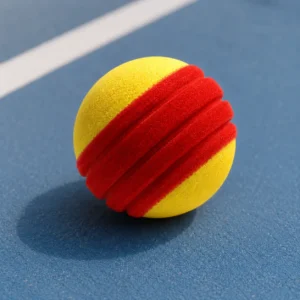
Players supply their own equipment: a 22-inch strung carbon fiber racket and a 3.5-inch channeled foam ball. Neither requires any facility-side hardware beyond the court itself. The sport was designed to scale through the existing pickleball network. Any existing pickleball court is already a TYPTI court. Your obligation as a facility operator is the surface, not the equipment chain.
Surface Requirements: Acrylic, Cushioned Acrylic, and Modular Tile
Here is where facility owners need to pay attention, because this part of the TYPTI court requirements is the one most guides skip entirely.
TYPTI’s channeled foam ball bounces at a 43-degree angle off the court surface, roughly three times steeper than a pickleball’s 13-degree exit. That steep angle is intentional: it pops the ball up into the strike zone so players can swing through rather than crouch. It also means the ball reads the surface closely. Imperfections that a hard hollow pickleball masks become visible with TYPTI. So which surface types actually hold up?
Acrylic surfaces are fully compatible with TYPTI and cover most pickleball court installations. Standard outdoor acrylic systems provide the texture, consistency, and grip the channeled foam ball needs. If your courts run on acrylic, that check passes.
Cushioned acrylic systems also qualify. A Pro-Cushion mat layer under the acrylic surface doesn’t interfere with TYPTI ball behavior. Players with joint concerns often prefer the cushioned feel for extended sessions. If you already have a cushioned system, keep it.
Modular tile is where the answer gets more conditional. Interlocking tile systems are common in gymnasiums and indoor recreation centers. Most modular tile courts play acceptably for casual TYPTI. The concern is seam consistency: tile gaps and panel edges can produce slight bounce irregularities that matter more with TYPTI’s steeper angle than with pickleball. Well-maintained tile that sits flat and smooth will work. Panels that are lifting, cracked at edges, or misaligned should be addressed before you invest in TYPTI programming.
Worn or compromised acrylic deserves its own category. Peeling acrylic, active cracking, persistent birdbaths: each affects TYPTI play quality more than you’d expect. The channeled foam ball grips the surface to generate spin. Rough, uneven, or pocked courts produce unpredictable ball behavior at the bounce point. Courts that have been deferred past their maintenance window need evaluation before you build a TYPTI schedule around them.
We’ve assessed courts for facilities across 25+ states where the surface looked adequate at a glance and turned up active crack telegraphing under the most recent coat. It’s not visible from the sideline. It shows up in the bounce. The right time to find that is before your members experience it during a TYPTI clinic, not after.
Line Markings: Nothing New Required
The question comes up in nearly every facility conversation.
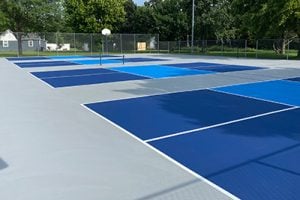
TYPTI uses standard pickleball court markings. Baselines, sidelines, centerlines, service boxes: all the same. The non-volley zone line (kitchen line) remains visible on the court but carries no function in TYPTI play. Players can volley from anywhere, including the kitchen, so the line sits inert.
This matters directly for clubs running both sports on the same courts. You don’t need separate striping schemes, dual-sport line configurations, or any additional paint work. One court, one line set, two sports.
The No-Kitchen Rule and What It Means for Surface Wear
TYPTI eliminates the non-volley zone entirely. Players can volley from any position, right up to the net. That’s one of the sport’s structural differences from pickleball, and it changes where wear happens on your courts.
Pickleball concentrates heavy foot traffic in a narrow band behind the kitchen line. That seven-foot zone on each side of the net sees constant lateral movement, pivoting, and stopping as players dink and reset. Over time, this produces visible scuffing in a predictable stripe across the court. Your maintenance team knows exactly where to look.
TYPTI spreads foot traffic more broadly. Players charge the net from deeper court positions, so the lateral-push wear distributes across more of the surface. Does that mean faster total wear? Not necessarily. But the pattern differs from what your maintenance crew may be used to monitoring, and it means the whole playing surface needs inspection during seasonal checks, not just the kitchen zone.
Look: if you’re programming TYPTI alongside pickleball on shared courts, adjust your maintenance review scope accordingly.
Reading Your Courts Before You Add TYPTI Programming
A court that hosts pickleball without complaints can still fall short for TYPTI if the surface is further along its wear cycle. Before launching TYPTI programming, walk the courts and check for four things.
Cracking. Hairline surface cracks in the acrylic coating are common and often cosmetic. Structural cracks that run through the base layer, telegraph through a recently applied surface coat, or widen with seasonal freeze-thaw cycles are a different matter. TYPTI’s foam ball reads surface level changes at the bounce point. A crack with any vertical displacement will produce a bad bounce at that spot, and players notice quickly.
Low spots. Birdbaths signal drainage or settling problems beneath the surface. For TYPTI specifically, soft or saturated zones compromise the consistent bounce the foam ball depends on. A birdbath that collects water and stays wet for days after rain is telling you something about the base, not just the surface.
Surface texture. Worn acrylic feels smooth underfoot and looks visually uniform. It also provides less grip for the channeled foam ball to generate the spin that defines TYPTI play. If your courts feel slick relative to new acrylic, players will register it quickly.
Delamination. Acrylic that’s lifting at edges or bubbling mid-court needs attention before you add any programming. For TYPTI, it’s both a safety issue and a surface performance problem.
Courts that pass all four checks are ready for TYPTI as-is. Courts with problems in one or more categories need a written assessment before you commit.
Across 1,000+ completed projects, we see a consistent pattern: facilities that skip the surface evaluation step end up managing member complaints after launch rather than before it. The conversation is much easier before you open the courts for a new sport.
Indoor Courts: One Additional Factor
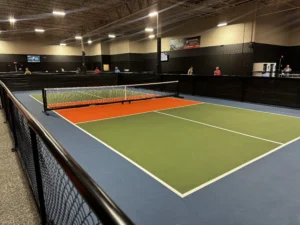
Most TYPTI programming will run outdoors, where standard pickleball courts are most common. But if you’re considering hosting TYPTI on indoor courts, ceiling clearance is worth checking before you finalize programming.
TYPTI’s 43-degree bounce angle means the ball travels significantly higher off the court than a pickleball. USA Pickleball specifies a minimum indoor ceiling clearance of 18 to 20 feet. That’s the same standard that applies to TYPTI, and it’s one your indoor courts should meet before you open high-arc TYPTI rallies in a gymnasium with low beams.
On the surface side, PTT’s indoor scope covers surface work only: resurfacing existing indoor courts and applying surface systems on completed indoor concrete. Building shell, HVAC, and structural work are general contractor territory. If your indoor courts need surface work to qualify for TYPTI, that’s a PTT project. If they need structural renovation, that’s a separate conversation.
Getting a Written Assessment Before You Invest in Programming
“You have to figure out what do they need, what do they want, and what is the pain associated with whatever the problem is.” Lance Laurent, President, Pro Track & Tennis
That framing applies directly to TYPTI readiness decisions. Some facilities have courts in solid condition that need nothing. Some need crack repair before launch. Some need a full resurfacing cycle to deliver the surface consistency TYPTI players expect. How do you know which category you’re in? The only real answer is a written assessment of the actual courts.
Pro Track & Tennis provides written court assessments for pickleball court construction and resurfacing decisions across 25+ states. PTT works with in-house crews on every project, no subcontracting, with 30+ years and 1,000+ completed projects behind the assessment process. If you’re considering TYPTI programming, an assessment tells you whether your courts qualify as-is or what surface work belongs on the schedule first.
Call 800-498-4395 or email info@protrackandtennis.com to request one.

FAQ
Can you play TYPTI on a standard pickleball court?
Yes. TYPTI is designed for standard 20-by-44-foot pickleball courts with no dimensional changes. The net height, markings, and court footprint are identical to what facilities already have.
Do you need new line markings for TYPTI?
No. TYPTI uses standard pickleball court markings. The kitchen line stays visible but is inactive in TYPTI because there is no non-volley zone. Players can volley from anywhere, so no additional striping is needed.
What surface types qualify for TYPTI?
Acrylic and cushioned acrylic surfaces are fully compatible. Modular tile works if it’s flat, well-maintained, and seam-consistent. Worn, cracked, or poorly draining surfaces affect TYPTI ball behavior more noticeably than pickleball because of the foam ball’s steeper 43-degree bounce angle.
How does the no-kitchen rule change surface wear patterns?
Without a non-volley zone, foot traffic distributes across more court area rather than concentrating behind the kitchen line. Clubs running heavy TYPTI volume should monitor the full playing surface during seasonal maintenance checks, not just the kitchen zone.
Can a converted tennis court serve as a TYPTI venue?
In most cases, yes. Tennis court conversions done with proper acrylic resurfacing typically produce surface quality that meets TYPTI court requirements. Confirm the existing surface is in good condition and check for visual crowding from tennis line markings still visible beneath the pickleball lines. A surface assessment can clarify what you’re working with before you commit to programming.
Does Pro Track & Tennis do court assessments for TYPTI readiness?
Yes. PTT provides written surface assessments across 25+ states. Contact us at 800-498-4395 or info@protrackandtennis.com before you commit to TYPTI programming.
Pro Track & Tennis provides multi-purpose court surfacing and pickleball court construction across 25+ states. ASBA member. Call 800-498-4395 or email info@protrackandtennis.com.
Sources
- TYPTI – official site (About / rules)
- The Hollywood Reporter – Steve Bellamy launches TYPTI; Tennis Channel to air championships
- Front Office Sports – Drew Brees and celebrity investors back TYPTI
TYPTI is a trademark/name associated with TYPTI Inc. Pro Track & Tennis is not affiliated with or endorsed by TYPTI Inc. This article is for facility planning and educational purposes only.