
Uncategorized
Understanding Standard Tennis Court Size: Dimensions and Importance
Updated on
·
10 min read

Published by

Key Takeaways
A singles court is 78 feet long and 27 feet wide; doubles widens it to 36 feet with two 4.5-foot alleys.
The net is 3 feet high at the center, and the posts stand 3 feet outside the doubles sidelines.
The service boxes and service lines are the same for singles and doubles.
Allow about 7,200 square feet for a court with its run-off zones; fencing, seating and paths add to that.
Public courts need ADA access routes, seating and signage, and lighting that is even and glare-free.
The dimensions of a tennis court directly influence how the game is played, from player strategy to movement, spin, and shot selection. The playing field must be standardized to ensure fairness and consistency in tennis at all levels. Accurate court sizes maintain the integrity and consistency of the sport across all competitive levels.
A standard tennis court measures 78 feet in length and 27 feet in width for singles matches, expanding to 36 feet wide for doubles, according to the International Tennis Federation (ITF) standards.
Understanding these dimensions is essential not only for players but also for all individuals involved in tennis court design and play, including coaches, facility managers, and constructors who need to ensure their courts provide fair and safe play.
Whether you’re building a new facility or upgrading an existing one, tennis court construction & resurfacing plays an important role in maintaining regulation standards, player safety, and long-term performance.
Our team at Pro Track and Tennis has completed 1,000+ projects across 25+ states, and we are committed to adhering to the ITF’s specs to guarantee optimal performance and player satisfaction with every court. In this article, we’ll dive into everything you need to know about tennis court dimensions.
Grasping the details of tennis court dimensions and standards is crucial for proper court design, regulation, and gameplay.
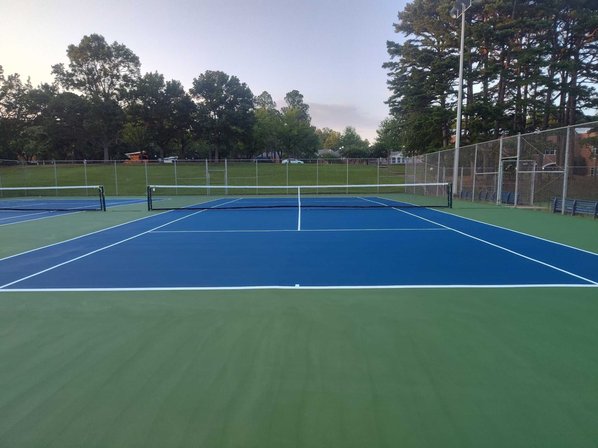
Standard Tennis Court Size
Let’s start with the basics – how big is a typical tennis court?
The universally accepted standard tennis court length is 78 feet. A single court, or singles court, measures 78 feet long and 27 feet wide. The width of the court for singles is 27 feet, while for doubles it is 36 feet, highlighting the importance of the width of the court in defining playing boundaries. These dimensions are utilized in all professional tournaments and competitive matches worldwide.
The distance between the baselines is 78 feet, and the distance between the singles sidelines is 27 feet. The court is divided down the middle widthwise by the center service line, which is responsible for dividing each side into two service boxes.
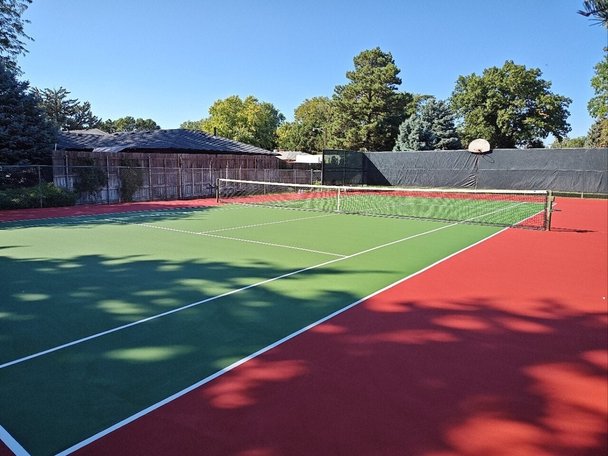
Lengthwise, each baseline marks the end of the court. The net splits the court into two halves, and the center service line plays a key role in dividing the court for proper player positioning. The net is suspended at a height of 3 feet in the center, creating the boundary for play on a long 78-foot court.
The court boundaries are clearly marked with lines, including sidelines, baselines, and service boxes, to define playable areas and enforce rules.
These dimensions allow ample room for players to maneuver effectively during play, supporting a dynamic and engaging style of play. Whether for recreational or professional use, maintaining these measurements is essential to ensure consistency and fairness.
The Ultimate Guide to Maintaining Your Track and Court Surfaces
Planning a tennis court project? Download the Tennis Resurfacing Guide
Court Markings and Features
What makes a tennis court a tennis court? It’s not just the lines, but also the essential markings.
These include the:
Baseline
Sidelines
Service lines
Center service line
The court is also sectioned into key areas such as service boxes, doubles alleys, and the so-called no man’s land. The service boxes and service lines are marked on each side of the net, ensuring accurate placement for serving and gameplay.
The center mark on the baseline assists players in positioning themselves properly during serves, while net posts are strategically placed 3 feet outside the doubles sidelines to support the net securely. The net line runs parallel to the net, marking its placement clearly.
These markings and features provide guidance for players’ movement and positioning, forming the foundation of regulated tennis play.
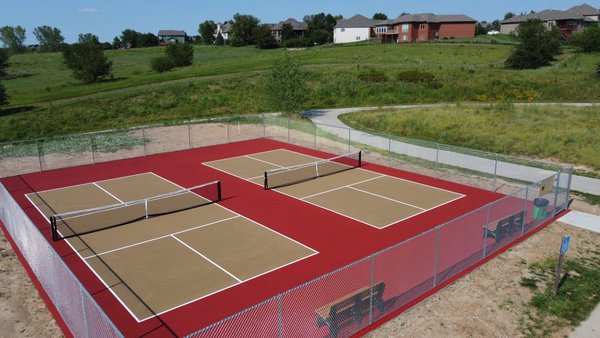
Get in touch to learn about our options for your tennis courts.
Doubles Court Dimensions and Alleys
For doubles matches, the court width extends to 36 feet. This adds the doubles alleys – each 4.5 feet wide – that run along the sides of the court, which are out-of-bounds for singles. In contrast to singles courts, this extra width significantly influences gameplay, strategies, and player positioning in doubles. These alleys offer additional space that doubles players utilize during fast-paced, strategic gameplay.
The doubles sidelines mark the outer boundary for doubles matches and define the extra width not used in singles play.
Notably, the service boxes and lines remain identical for both singles and doubles, ensuring consistency in service rules.
This wider configuration meets the unique spatial demands and strategic nature of doubles tennis.
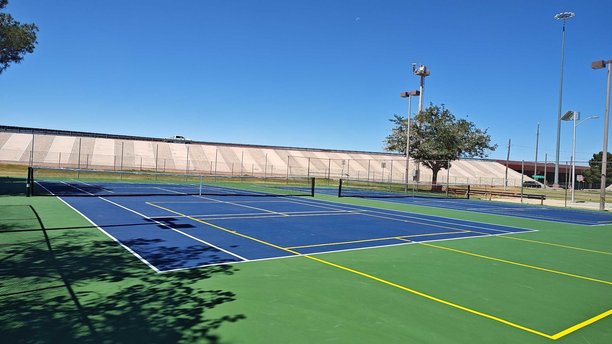
What other sports can fit on a multi-use tennis court? Find out here.
Court Surfaces and Types
Tennis court surfaces come in several types, each offering distinctive characteristics that influence gameplay. The main tennis court surfaces include grass, clay, hard, and synthetic options.
Grass and clay courts are traditional surfaces, with grass courts prized for their fast pace and low bounce, while clay courts slow the game down with a higher bounce, favoring baseline rallies and strategic play. Both grass and clay courts are high maintenance, requiring regular watering and upkeep to maintain optimal playing conditions.
Hard courts are a popular choice for many facilities. These courts are made from durable materials like asphalt and concrete, providing a fast, consistent surface. Hard courts serve as a middle ground between grass and clay, offering a balance of speed, bounce, and maintenance requirements.
Synthetic courts, such as latex and artificial turf, offer versatility and durability.
The choice of surface significantly impacts player performance, style, and the overall game experience. For outdoor courts, surface selection may differ from indoor environments due to weather exposure and maintenance needs. Facilities often select court types based on regional climate, usage frequency, and maintenance preferences.
As every playing surface ages differently, professional tennis court resurfacing helps restore consistent playability while preserving the performance characteristics of each court type.
It’s worth noting that tennis court dimensions can slightly vary depending on the type of court (indoor, clay, or grass, for example) but the official measurements remain the benchmark for competitive play.
Guide to choosing the right track surface for your facility
Learn more about tennis court surface material options – and which is best for you.
Lighting Requirements
Beyond the surface, proper lighting is vital for safe and enjoyable tennis, particularly for indoor courts and evening play. Proper illumination helps ensure player safety by reducing the risk of accidents and injuries caused by poor visibility, glare, or shadows.
A well-designed lighting system provides uniform illumination across the entire court, with a recommended minimum lux level of 500 to meet competitive standards, which is crucial for player safety.
LED lighting is increasingly popular due to its energy efficiency, longevity, and reduced glare, which enhances player visibility. In addition, the addition of LED lighting can further improve safety and visibility on the court.
Lighting requirements may vary depending on court surface, location, and level of play, but ensuring adequate brightness and minimal shadows is essential to minimize the risk of injury.
Additionally, it is important to consider minimizing glare and ensuring uniform coverage to optimize both performance and player safety.
Get in touch to learn about our options for your tennis courts.
Tennis Court Accessibility and ADA Compliance
Ensuring tennis courts are accessible to everyone is essential, particularly for public facilities like schools and recreation centers. Courts must comply with the Americans with Disabilities Act (ADA) standards, which outline requirements for accessible routes, seating, and amenities.
Accessible design includes features such as:
Properly graded pathways leading to and around the court
Designated wheelchair seating and viewing areas
Clear signage and accessible restrooms nearby
These considerations allow players with mobility challenges to enjoy the sport safely and comfortably. When planning or upgrading courts, integrating ADA guidelines not only meets legal obligations but fosters inclusivity and community engagement.
Learn more about how you can create the perfect tennis court facility.
Space Requirements and Court Size
Beyond the court dimensions, it is essential to consider the total area required for a standard tennis court, which is typically about 7,200 square feet. This total area includes the playing surface as well as the recommended run-off zones around the court to ensure player safety and proper movement.
Unobstructed spaces around the court are crucial for safe gameplay. These spaces, including the areas above the net and baseline, must be free of obstructions to allow for safe play and to meet regulation standards.
It is also important to keep any fixed obstruction, such as fences or walls, at a safe distance from the court boundaries. Maintaining the correct distance ensures compliance with safety regulations and provides optimal playing conditions.
Additional space might be needed for spectator seating, fencing, pathways, and landscaping depending on the facility’s purpose and scale.
Residential courts, for example, may have different spatial constraints compared to tournament courts designed for larger crowds and media coverage.
Ulysses High School Track Gets a Colorful Upgrade
Make your courts look great with these color strategies!
Understanding No Man’s Land
“No man’s land” is the area between the baseline and the service line. This zone is critical in tennis strategy, acting as a transitional space where players shift between defensive and offensive play.
Positioning in no man’s land requires quick reflexes and sound judgment, as players must react rapidly to shots coming from both the net and the baseline. Competent navigation of this area often determines the outcome of rallies and games.
Mastering the tactical use of no man’s land is a key part of advanced tennis play, with nuanced tactics and strategies embraced by skilled players.
Court Construction and Maintenance
Court construction and maintenance are critical for providing a high-quality playing experience for all players.
As contractors that are ASBA members, our team at Pro Track and Tennis emphasizes dimensional accuracy throughout construction to ensure every court is tournament-ready.
Each project involves detailed planning and precise execution to meet the stringent dimension and safety requirements. The surface, fencing, and lighting must all be installed to professional standards.
Regular maintenance is equally important, including cleaning, resurfacing, and repairing nets and fences, which keeps the court safe and playable for years.
Scheduling tennis court resurfacing services at the right interval helps extend court life, improve player safety, and maintain consistent ball response throughout the facility.
Well-maintained courts preserve your investment value and enhance the player experience.
Want help with your next tennis court project? Get in touch for a free assessment.
Factors Affecting Court Dimensions and Gameplay
Court dimensions and gameplay are influenced by multiple factors. The type of court surface affects ball speed and bounce, which in turn alters player tactics. Different surfaces can favor different playing styles; for example, clay courts slow the game down, while grass courts speed it up. As a result, players must be focusing on specific skills or strategies suited to each surface, such as stamina and concentration on clay or quick reflexes on grass.
The level of play also impacts court specifications; professional venues demand greater precision and superior materials.
Environmental elements such as lighting conditions, temperature, and humidity further affect how the game unfolds and how surfaces perform. Facility managers must consider these variables when designing and maintaining courts to optimize player satisfaction.
Learn more about how you can create a flawless tennis court surface.
Choosing the Right Tennis Court Contractor
Selecting the right contractor is crucial to the success of any tennis court project. Experienced contractors bring specialized knowledge of design, materials, and installation techniques that ensure courts meet all dimensional and safety standards.
Look for contractors who:
Are members of the American Sports Builders Association (ASBA)
Have a proven track record with institutional and recreational facilities
Use specialized application equipment and high-quality materials
Provide transparent project timelines and budgets
Partnering with a reputable contractor reduces risks, maximizes court longevity, and ensures a finished product that players and administrators can trust for years to come.
Our team at Pro Track and Tennis is a member of ASBA and has completed 1,000+ projects across 25+ states. We can help you plan every stage of your project with consistent execution, starting with a free on-site assessment.
Want help with your next tennis court project? Get in touch for a free assessment.
Conclusion and Final Thoughts
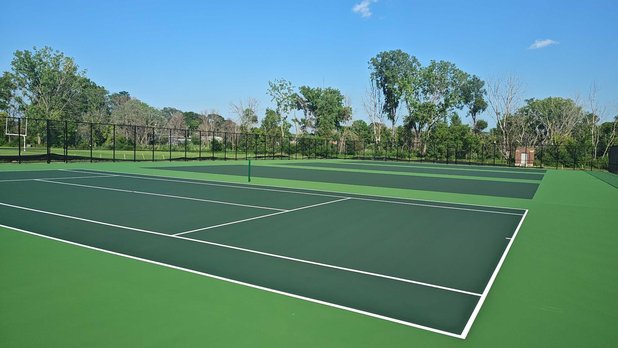
Understanding standard tennis court size is essential for players, facility managers, and builders alike. Precise measurements translate into fairness and safety, while court surface type and environmental factors can significantly influence play style and performance.
With knowledge of how these elements interact, facilities can better plan, construct, and maintain courts that meet competitive standards and player needs. Whether planning a new court or upgrading an existing one, attention to detail ensures a superior tennis experience.
If you’re considering a tennis court project, our team of ASBA member contractors offer free assessments to help your facility meet all dimensional and regulatory requirements. Contact Pro Track & Tennis for expert guidance tailored to your needs.
Get a Free Assessment for Your Court or Track
Our in-house crews have completed 1,000+ projects across 25+ states. Tell us about your facility and we will inspect the surface and give you a straight plan and quote.
Get Free Assessment
»
About the Author
Marketing Manager, Pro Track & Tennis
Recent Blog Posts
Discover More →
•
8 min read
Plan your fall court and track resurfacing project: when to book, how budget cycles fit in, and how to sequence multiple surfaces.
•
8 min read
Your tennis court cracked again after resurfacing? Learn why reflective cracking happens and what actually stops an old crack from reappearing.
•
7 min read
Learn how tennis court resurfacing timing affects downtime, from weather windows to phasing multi-court facilities without closing everything at once.
•
7 min read
TYPTI vs. pickleball for clubs: court, equipment, and rules differences, plus a decision framework on adding TYPTI or switching entirely.
•
10 min read
How to host TYPTI at your club: equipment, court readiness, programming, marketing, and the revenue model, compared to pickleball benchmarks.