


Key Takeaways
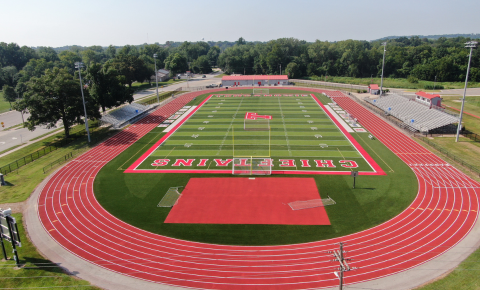
- A standard high school outdoor track measures 400 meters in Lane 1, and most U.S. high schools follow this format.
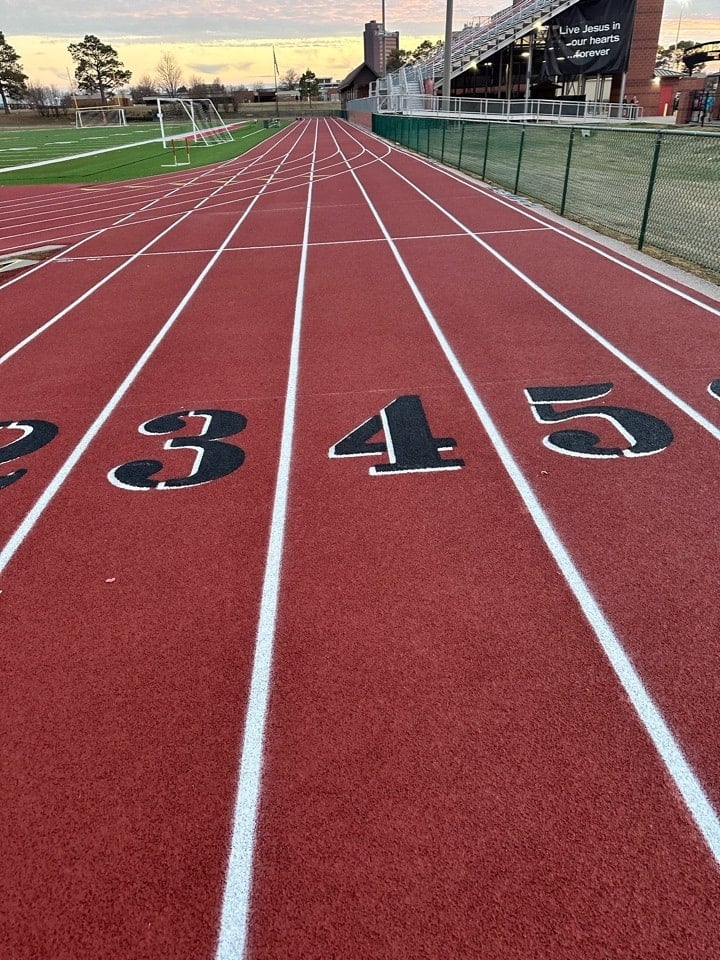
- Typical high school tracks have 6 to 8 lanes, each about 1.22 meters (4 feet) wide, usually built around a football or soccer field.
- Some schools use 300 m or other non-standard tracks due to space or budget limits, which affects meet eligibility and event setup.
- Track length is measured along a specific reference line in Lane 1, following NFHS and World Athletics conventions.
- Facility leaders planning new construction or major resurfacing should request a free track assessment from Pro Track & Tennis to verify dimensions, evaluate base conditions, and develop accurate budget projections.
The Standard Length of a High School Track
So, how long is a high school track?
The direct answer is simple: a standard high school track is 400 meters (1,312.34 feet or 437.45 yards) when measured in Lane 1.
That 400-meter standard is used by the vast majority of U.S. high schools and aligns with guidelines from the National Federation of State High School Associations (NFHS), which closely mirror World Athletics standards. This consistency is intentional. It ensures that race times recorded at one school are directly comparable to those recorded at another regulation facility.
From a facility management standpoint, this matters more than most people realize. A regulation-length track protects your program’s ability to host meets, supports athlete development, and prevents future headaches during resurfacing or certification reviews.
Schools planning long-term maintenance should also evaluate high school track resurfacing as part of their facility lifecycle strategy to preserve performance and maintain compliance with competition standards.
How the 400 Meters Is Measured
The 400 meters is not measured curb-to-curb or paint-to-paint at random. It follows precise conventions designed to represent the athlete’s natural running path in the inside lane.
|
Condition |
Measurement Reference |
|---|---|
|
Raised curb present |
30 cm from the inside curb |
|
No raised curb (painted line only) |
20 cm from the painted line |
That measurement line runs continuously around the oval for one complete lap.
This detail becomes important during resurfacing and reconstruction. If the curb moves, the line shifts, or the geometry drifts over time, the track can quietly fall out of specification, even if it still “looks fine.”
Pro Track & Tennis has evaluated aging tracks across 25+ states where drift occurred gradually over decades. In most cases, facility managers had no idea their track was out of spec until they planned resurfacing, at which point correction costs became significant. If your track is more than 15 years old or has been resurfaced multiple times, a measurement verification should be your first step before committing to any work.
The Basic Oval Layout
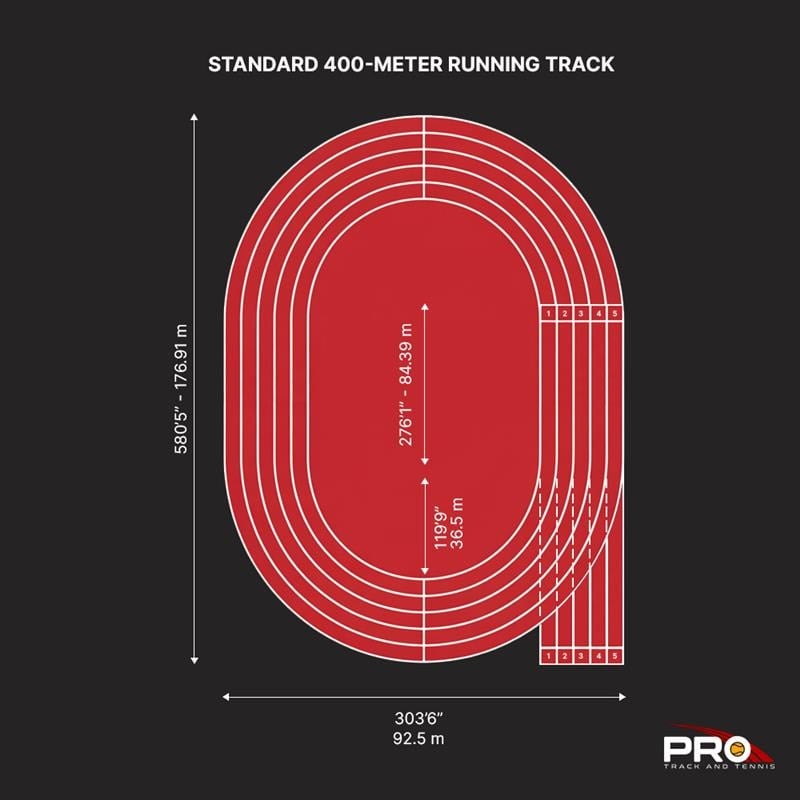
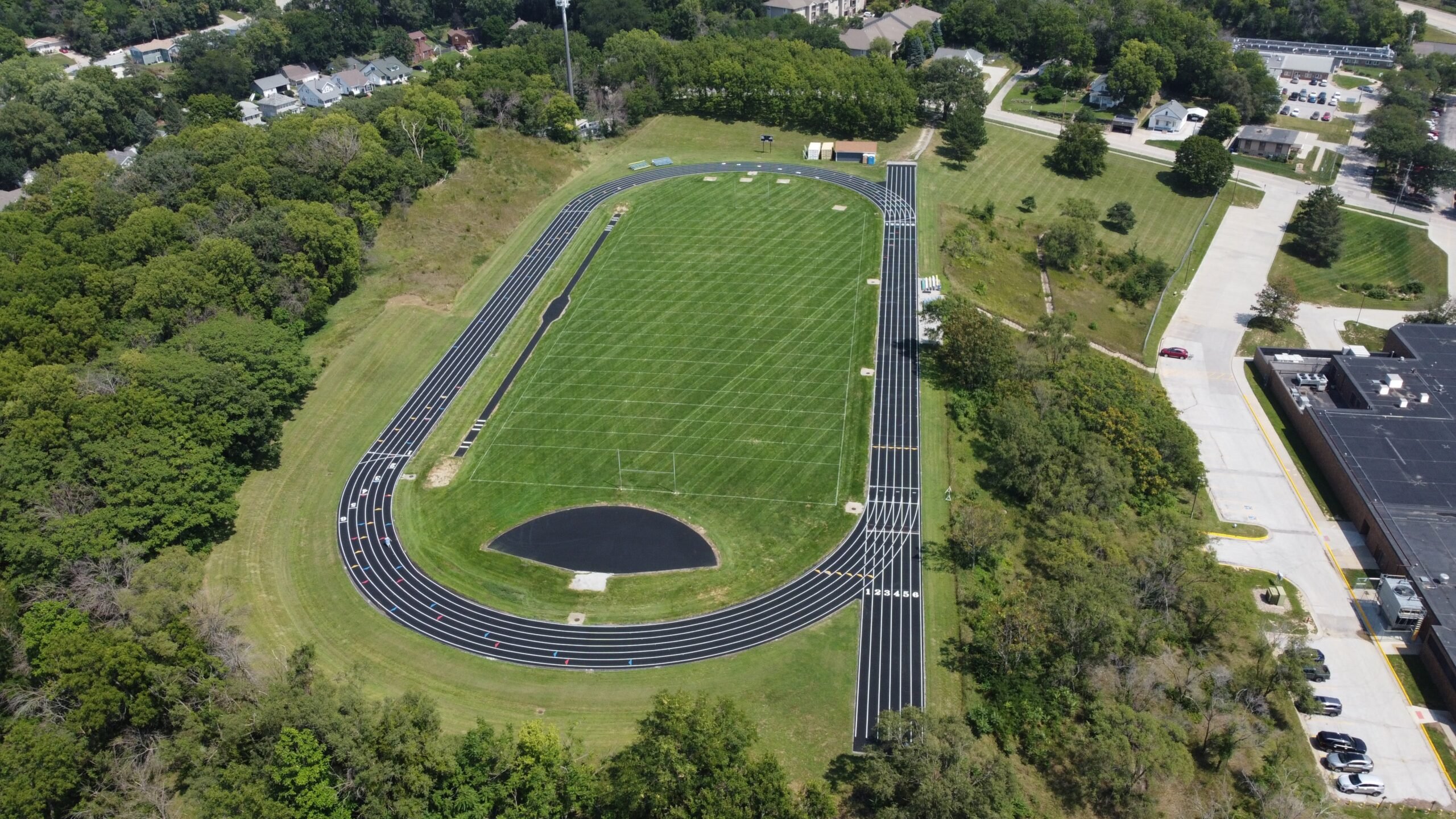
A 400 m track is not a perfect circle. It consists of two straightaways, each roughly 84 to 85 meters, and two semicircular curves connecting the straights. The geometry affects curve radii and straight lengths, but when built correctly, Lane 1 always totals 400 meters.
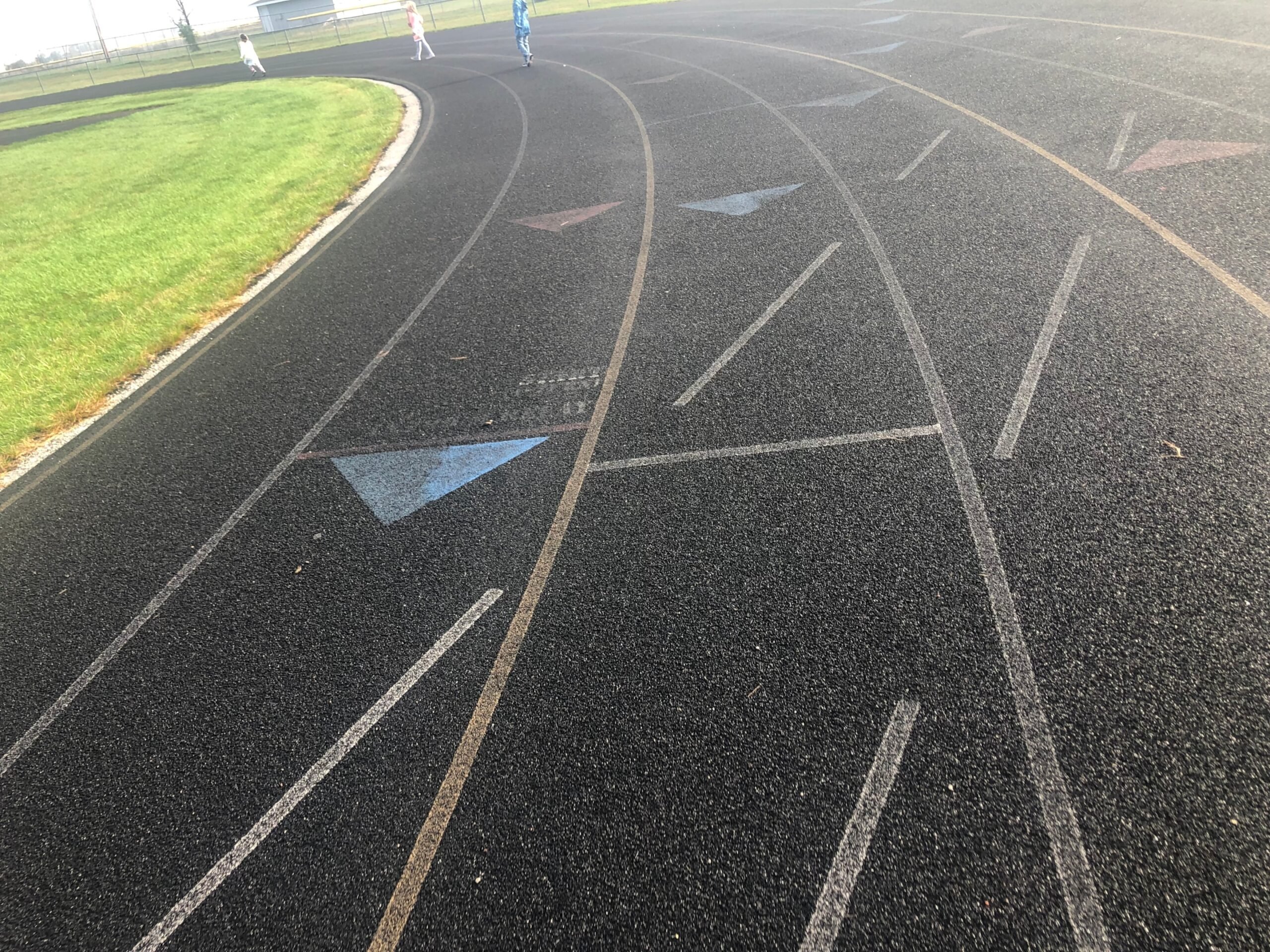
Here’s a point that often surprises coaches and administrators: one lap in Lane 1 equals 400 meters, but outer lanes are significantly longer. On a standard eight-lane track, Lane 8 can be more than 50 meters longer per lap than Lane 1. That’s why staggered starts are required for races that include curves, so every athlete covers the same official distance.
Getting stagger marks accurate during initial construction and maintaining them through resurfacing cycles requires surveying equipment and field experience. Pro Track & Tennis uses total station technology on every project, whether it’s a new 400m facility or a maintenance job, because measurement drift compounds over time. Small errors in year one become visible geometry problems by year twenty.
Typical High School Track Dimensions & Layout
While the lap distance is standardized, the exact geometry of a high school track varies based on site constraints and infield requirements.
Lane Counts
|
Configuration |
Typical Use |
|---|---|
|
6 lanes |
Smaller schools, practice-focused programs |
|
8 lanes |
Championship-capable facilities and larger programs |
Eight lanes remain the most common for high school competition, though some newer facilities include an extra outer lane for overflow or safety.
Lane Width
Standard lane width is approximately 1.22 meters (4 feet).
- 6 lanes ≈ 7.32 m (24 ft) wide
- 8 lanes ≈ 9.76 m (32 ft) wide
NFHS rules allow minor flexibility compared to strict World Athletics standards. In some cases, that flexibility can reduce construction costs without sacrificing eligibility for scholastic competition.
Geometry Ranges (Typical)
- Straights: ~84 to 85 meters
- Inside curve radius: ~36 to 38 meters
- Overall footprint (oval only): ~176.9 m long × ~92.5 m wide
Exact numbers vary by design, but the requirement remains the same: Lane 1 must measure exactly 400 meters.
Infield Integration
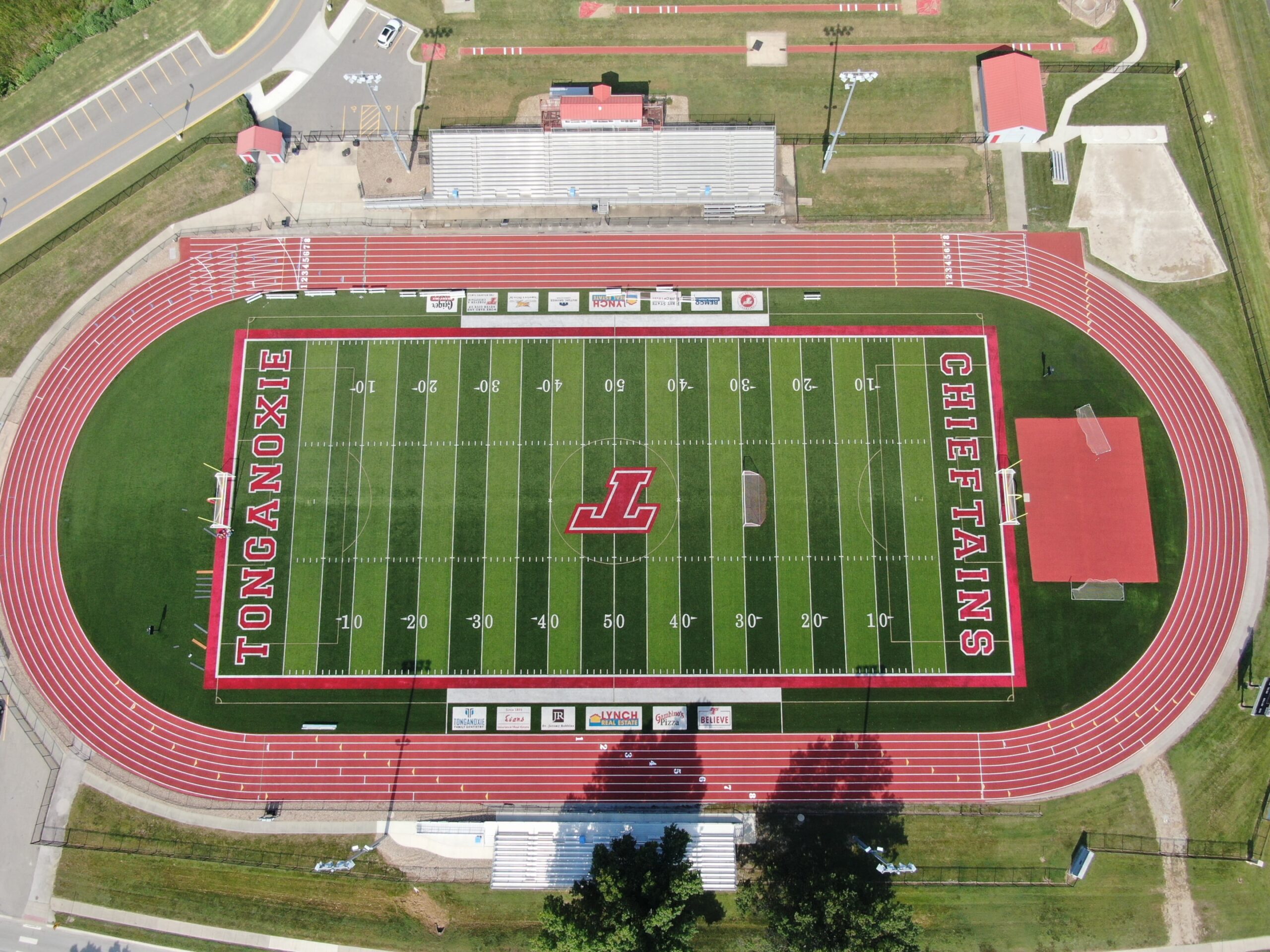
Most high school tracks surround a full-size football or soccer field. A regulation American football field measures 360 ft × 160 ft (120 yd × 53⅓ yd), which fits comfortably inside a standard 400 m oval. This shared-use design influences D-areas at the curve ends, runoff zones for safety, and placement of long jump, pole vault, and throwing events.
Land Use Context
|
Component |
Approximate Footprint |
|---|---|
|
Track + infield |
1.5 to 2 acres |
|
Full complex (access, runways, seating) |
5 to 6 acres |
For school districts planning new construction, these numbers provide a realistic baseline early, before design costs pile up.
These space requirements often surprise districts in early feasibility discussions. Pro Track & Tennis works with schools during site selection and master planning to identify space conflicts before architectural fees accumulate. In landlocked situations, the team has helped clients explore 6-lane configurations, modified infield dimensions, and creative grading solutions that preserve regulation length while fitting constrained sites.
Standard vs. Non-Standard High School Track Lengths
Not every school has the space or budget for a full 400 m track. Non-standard layouts exist for practical reasons: landlocked or older campuses, budget constraints, and legacy facilities built before metric standards were common.
300-Meter Tracks
A 300 m track uses the same oval concept but with shorter straights and tighter curves, roughly 20 to 25% less linear space than a 400 m track. These tracks work for PE and training but complicate standard race distances and meet hosting.
Legacy Quarter-Mile Tracks
Many older schools still have 440-yard (402.34 m) tracks built decades ago, often with asphalt or cinder surfaces. These are gradually being converted to true 400 m layouts during major renovation cycles.
Pro Track & Tennis has converted quarter-mile tracks to true 400m layouts during resurfacing projects. When the base is sound, this conversion typically adds minimal cost compared to standard resurfacing, making it an ideal time to bring older facilities into compliance without triggering a full reconstruction budget.
Practice-Only Configurations
Some schools rely on short practice ovals, straight sprint lanes, or PE-focused layouts not intended for competition.
Competition Implications
|
Track Type |
Eligible Events |
|---|---|
|
Certified 400 m – learn what to expect when working with Pro Track and Tennis |
State, regional, record-eligible meets |
|
Learn more about non-standard athletic court and track surfaces designed and installed by Pro Track & Tennis. |
Practice and some local dual meets |
If hosting championship-level events is a priority, a certified 400 m facility is essential.
How Track Length Is Measured & Marked
Track measurement is governed by strict standards so times remain comparable across facilities.
Lane 1 as the Reference
All official measurements are based on Lane 1, following the defined reference line near the inside edge.
Outer Lane Distances (Approximate)
|
Lane |
Distance per Lap |
Difference from Lane 1 |
|---|---|---|
|
1 |
400.00 m |
— |
|
2 |
407.04 m |
+7.04 m |
|
3 |
414.70 m |
+14.70 m |
|
4 |
422.37 m |
+22.37 m |
|
5 |
430.03 m |
+30.03 m |
|
6 |
+37.70 m |
|
|
7 |
445.36 m |
+45.36 m |
|
8 |
453.03 m |
+53.03 m |
These differences explain why stagger accuracy is critical and why resurfacing without re-verification can create problems.
Why Professional Layout Matters
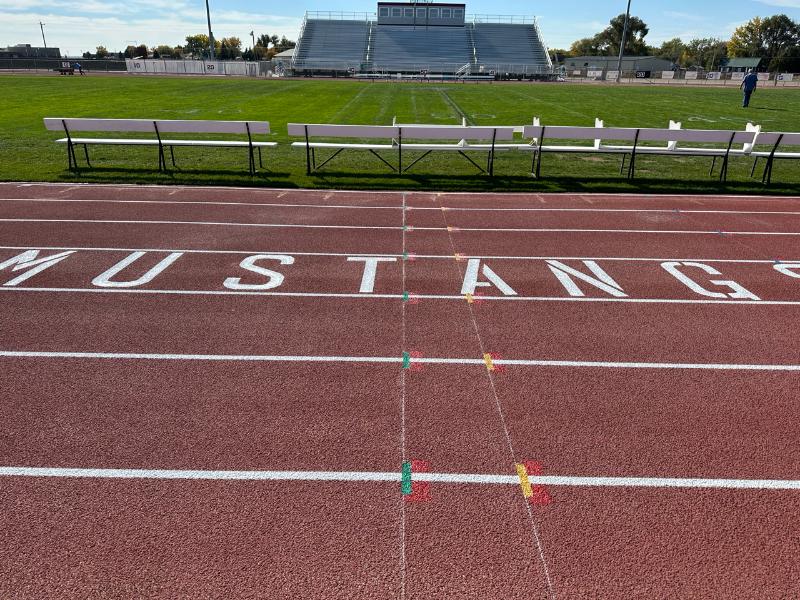
Accurate construction requires licensed surveyors, total stations and verified templates, and precise marking of starts, finishes, and staggers.
Small layout errors compound over time, especially after multiple resurfacing cycles. Pro Track & Tennis verifies measurements at the start of every resurfacing project, not just new construction. In older facilities, geometry drift that needs correction is sometimes discovered before new surface goes down. Catching these issues early prevents wasted material costs and future certification problems.
High School Track Construction Basics
Getting the length right is only part of the equation. Longevity depends on what’s under the surface.
Typical Construction Layers
- Compacted subgrade
- Stone base for drainage
- Asphalt base course
- Synthetic surface system (latex or polyurethane)
Shortchanging any layer leads to predictable problems: cracking, settlement, drainage failure, and early surface breakdown.
Drainage and Grading
Proper grading prevents water retention:
- ≤0.1% slope in the running direction
- ≤1% cross slope toward the inside
When drainage is wrong, geometry eventually shifts, turning a regulation track into a costly liability.
Pro Track & Tennis has built regulation 400m tracks in climates ranging from northern winters to southern heat. In every region, proper drainage engineering during initial construction prevents most of the premature failures the team is called to repair. Projects include geotechnical analysis, engineered stone bases, and surveyed grading, not because these add cost arbitrarily, but because they prevent much larger expenses during the track’s operational life.
The difference shows up clearly in project lifespan. Tracks built with proper drainage engineering can reach their expected lifespan before needing resurfacing. Tracks where drainage was value-engineered out during construction often need intervention years earlier, and the “savings” from skipping proper base work gets consumed several times over in early repairs and shortened surface life.
Evaluating drainage and base conditions before professional track resurfacing helps schools avoid recurring failures and maximize the lifespan of the new surface.
As an ASBA member company with in-house crews, Pro Track & Tennis controls quality from base preparation through final striping. This integrated approach ensures drainage specifications are met during construction, not just designed on paper.
Track Surfaces, Climate, and Longevity
Even a perfectly sized track fails early if the surface system doesn’t match the climate and usage.
Common High School Surface Systems
|
System |
Best Fit |
|---|---|
|
Latex-bound rubber |
Budget-conscious programs |
|
Full-pour polyurethane |
High-use, championship facilities |
|
Premium systems |
Balanced cost and performance |
Climate Reality
- Freeze-thaw cycles stress adhesion and bases
- High UV accelerates aging
- Heavy rainfall exposes drainage flaws
With proper construction and maintenance, most high school tracks deliver years of reliable service before resurfacing is needed. Exact lifespan depends on climate, usage, and maintenance practices.
Pro Track & Tennis’s experience across 25+ states is consistent: most premature failures start in the base and drainage, not the surface. Schools sometimes need to replace surfaces earlier than expected because water is getting underneath. If proper base construction had been part of the initial project, that same surface would have delivered its full expected lifespan.
Resurfacing and Reconfiguring Existing High School Tracks
Many schools don’t need new tracks. They need smart resurfacing.
Typical Resurfacing Scope
- Cleaning and preparation
- Crack repair
- New wear layers
- Fresh striping and markings
Why Resurfacing Is a Key Checkpoint
Resurfacing allows you to verify measurements, correct layout errors, and convert quarter-mile tracks to true 400 m designs. When the base is sound, resurfacing can extend track life significantly at a fraction of full reconstruction cost.
For many school districts, running track resurfacing for high schools provides an opportunity to improve safety, restore playability, and extend facility life without the expense of a complete rebuild.
Before committing to full reconstruction, request a free base assessment from Pro Track & Tennis. The team will core test your existing base, verify current measurements, and provide cost projections for both resurfacing and new construction options. In many cases, smart resurfacing delivers years of additional service while preserving capital budget for other facility needs.
Designing Around Football or Soccer Fields
Shared stadiums are standard because they reduce land use and cost. But they create design challenges: runoff and safety buffers, sideline-to-Lane-1 spacing, and event placement conflicts.
Successful shared-use projects require coordination between track builders, civil engineers, and architects from day one, not after concrete is poured and utilities are locked in. Pro Track & Tennis routinely leads these coordination efforts for school districts, helping architects understand track-specific grading requirements, drainage implications, and event space conflicts before design errors become change orders.
Problems arise when football fields are graded first without considering track drainage, forcing expensive rework when the track contractor arrives. Issues also occur when utility trenches are cut through planned track base areas, compromising compaction and creating future settlement problems. These issues are preventable with early coordination.
Planning, Budgeting, and Partnering with Pro Track & Tennis
Understanding dimensions is step one. Lifecycle planning is where schools save money.
Smart Planning Steps
- Condition assessment
- Measurement verification
- Program needs analysis
- Early budget modeling
Investment Context
|
Project |
Scale |
|---|---|
|
New 400 m track |
Major capital project |
|
Resurfacing |
Planned, moderate investment |
|
Maintenance & crack repair |
Ongoing operational cost |
Early collaboration with an experienced track builder prevents dimensional errors, drainage failures, and under-designed bases that cut track life short.
Pro Track & Tennis provides free preliminary consultations for schools throughout the 25+ state service area. The team will review your site, answer budget questions, and help you understand whether your next step is resurfacing, reconstruction, or targeted maintenance. Assessments include visual inspection, measurement verification, and core sampling when needed, with written reports you can use for board presentations and capital planning.
With over 1,000 completed projects, Pro Track & Tennis has worked with schools on everything from crack repair to complete stadium construction. That experience means the team has seen most common problems before they surprise you, and knows which cost-saving measures actually work versus which ones create expensive problems down the road.
Contact the Pro Track & Tennis team at 402-761-1788 or info@protrackandtennis.com to schedule an assessment. Whether you’re two years away from a project or dealing with an urgent repair need, you’ll get straight answers about your options and realistic budget guidance.
Frequently Asked Questions
Is every high school track exactly 400 meters?
Most competition-ready tracks are, but older or space-limited facilities may use non-standard lengths. If hosting championship meets matters to your program, verification is worth the time.
How many laps make a mile?
Four laps equal 1,600 m. A true mile is four laps plus about 9.34 m, roughly the width of Lane 4.
Can we host official meets on a non-standard track?
Local meets may be allowed, but championship and record-eligible events usually require certified 400 m tracks. Check with your state athletic association for specific eligibility rules.
How do we know if our track is still regulation and safe?
A professional inspection verifies geometry, surface condition, and base integrity. Pro Track & Tennis offers free on-site assessments throughout the service region. You’ll receive a detailed condition report, measurement verification, and budget projections for any needed work, with no obligation. Call 402-761-1788 or email info@protrackandtennis.com to schedule.