Every running track proposal looks confident on paper. That’s the problem.
How to choose a running track contractor comes down to what a proposal doesn’t say as much as what it does. Two bids for the same track, from two different companies, can look nearly identical right up until the project starts. What separates them shows up in the field, not on the letterhead: who’s actually on-site, what’s excluded from the scope, and whether the credentials on the cover page hold up when you check them.
This guide walks through the specific things worth verifying before you sign anything, not the generic “look for experience and good reviews” advice you’ll find everywhere else.

Verify ASBA membership yourself, don’t take it on faith
A contractor’s website can say anything. ASBA membership is one of the few claims you can actually check in under five minutes.
Go to the American Sports Builders Association’s member search and look up the company by name. If they’re listed, the membership claim holds up. If they’re not, ask directly why the website says otherwise. It happens more than you’d think.
Membership itself isn’t a guarantee of quality. What it tells you is narrower and still useful: the company has some connection to industry standards for design, construction, and maintenance of tracks and courts, rather than treating a running track like a parking lot with lines painted on it.
Ask directly whether crews are in-house or subcontracted
This single question tends to separate the contractors worth talking to from the ones to cross off the list.
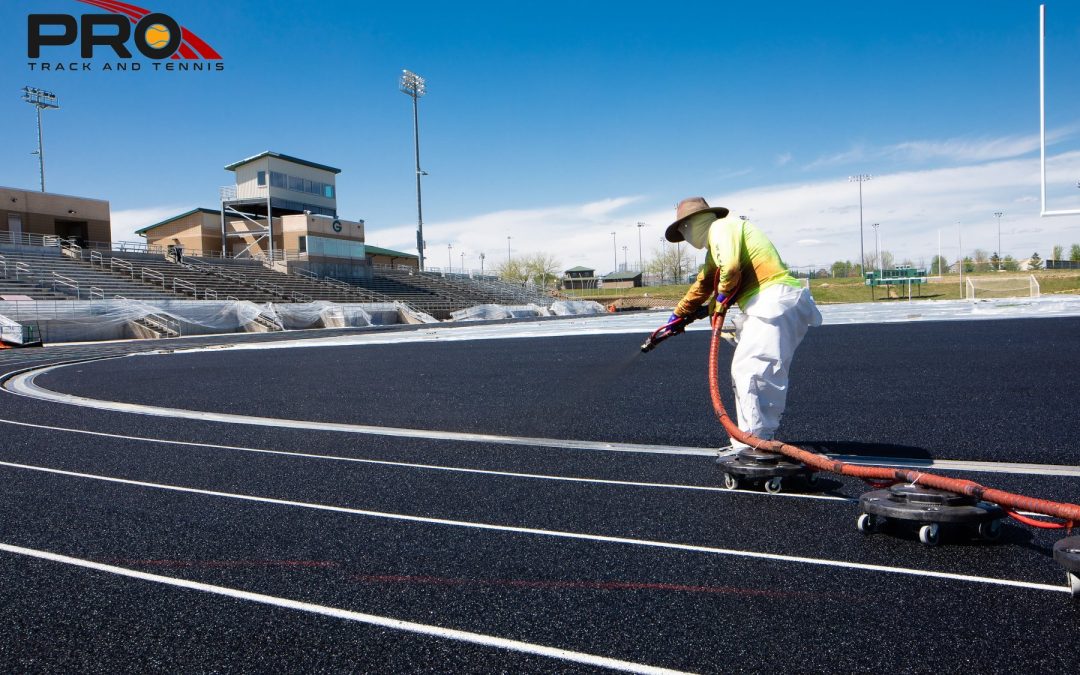
“We use our own crews. Once you start subbing stuff out, you lose control.” Lance Laurent, President, Pro Track & Tennis
Why does that matter so much? Because when a company subcontracts base prep to one crew and surfacing to another, accountability splits along with the labor. If the base fails two years later, the surfacing sub can point at the base contractor, and the base contractor can point right back. You’re left holding a track that’s failing and no single company that owns the outcome.
Ask the question plainly: who is physically doing the work, and are they employees of the company you’re signing a contract with? A confident, specific answer is a good sign. A vague one isn’t.
The proposal should also include a realistic project schedule, including site preparation, installation, curing time, weather delays, and when the track can safely reopen. Our running track construction timeline guide explains what to expect at each stage.

Read the proposal for what it leaves out
The scope section of a proposal tells you more than the price does.
A complete proposal names the exact system being installed, not just “resurfacing” or “track renovation” as a catch-all phrase. It specifies square yardage. It states who handles drainage work and base repair if problems turn up once work begins, rather than treating that as a change order waiting to happen. It includes a written condition assessment from an actual site visit, not a price built off satellite photos and a phone call.
Ask what happens if the base assessment turns up a problem mid-project. A contractor who’s thought this through has a clear answer. One who hasn’t will improvise, and improvising on your budget is not where you want them starting.
Red flags worth walking away from
Some warning signs are subtle. Others aren’t, and they still get missed because the rest of the proposal looks professional.
No written, on-site assessment before a number gets quoted. A price that arrives before anyone has walked your track isn’t a quote, it’s a guess dressed up as one. Vague scope language like “comprehensive resurfacing services” without a system name attached. Subcontractor disclaimers buried in the fine print, especially after the sales conversation implied an in-house crew. No willingness to name specific past projects you can call and ask about. And pricing that’s dramatically lower than every other bid with no explanation for the gap, since that gap almost always comes from somewhere.
None of these individually disqualifies a contractor. Together, they’re a pattern.
What a real site visit should actually involve
A site visit that consists of someone walking the track for ten minutes and taking a few photos isn’t an assessment. It’s a formality.
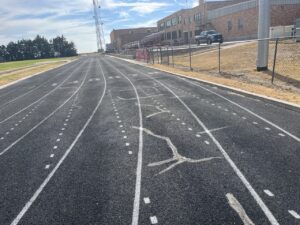
A real evaluation checks the base and drainage first, not the surface color. It looks for birdbaths, low spots where water pools after rain, since those are often the earliest visible sign of a base problem long before cracking shows up. It measures square yardage precisely rather than estimating from a satellite image. It asks what the facility is actually trying to solve, not just what surface they’d like installed.
That last part sounds obvious. It isn’t always practiced. Some contractors walk in already selling a specific system before they’ve heard what the school’s actual problem is: a compliance issue, a liability concern from tripping hazards, a lost regional meet, or simply a track that’s aged past its useful life. The assessment should shape the recommendation. It shouldn’t be the other way around.
If a contractor can’t articulate what they found in your base and drainage in specific terms, they didn’t really look. Ask them to walk you through it in their own words before you ask about price.

What about warranty terms?
Warranty language deserves scrutiny, but it’s a big enough topic that it gets its own dedicated coverage. In short: ask for warranty terms in writing, ask whether they cover labor as well as materials, and ask what voids the warranty. Our maintenance guide covers how warranty terms interact with ongoing upkeep in more depth.
Timing and climate experience matter more than most buyers expect
A contractor who’s only worked in mild, dry climates can still do fine work on a track in Georgia. Put that same team on a track in Minnesota, and freeze-thaw cycles they’ve never planned around become an expensive lesson at your expense.
Ask what climate-specific adjustments they make to base prep and drainage design for your region. A contractor who’s built and resurfaced tracks across genuinely different climates will have a real answer, not a shrug. Our construction guide goes deeper on how base and drainage decisions change by region, and budget-stage questions are covered in our resurfacing cost guide.
How Pro Track & Tennis measures up against this checklist
We wrote this guide from the buyer’s side of the table on purpose. Here’s where we land against our own questions, using only what’s verified: ASBA member. In-house crews on every project, no subcontractors. 30+ years in the business. 1,000+ completed track and court projects across 25+ states. A 2-year warranty on general installation work, provided in writing on every project.
That’s not a sales pitch buried in a how-to guide. It’s the same answer we’d want if we were the ones asking.
Frequently asked questions
How do I verify a contractor’s ASBA membership? Search the American Sports Builders Association’s member directory directly rather than relying on a claim made on the contractor’s own website. If the company isn’t listed, ask them to explain the discrepancy before moving forward.
Why does it matter if a contractor subcontracts the work? Accountability gets harder to pin down once multiple companies touch different phases of the project. If something fails later, a subcontracted crew has less incentive to stand behind work another company sold and scheduled.
What should a running track proposal include? A named surface system, documented square yardage, a written condition assessment from an actual site visit, and clear language about who handles unexpected base or drainage issues if they turn up mid-project.
What’s a reasonable red flag to walk away over? A firm price quoted before any site visit. Track condition varies too much to price accurately without seeing the base and drainage in person, so a pre-visit number usually means assumptions are doing the work numbers should be doing.
Does a lower bid always mean a worse contractor? Not necessarily, but a bid that’s dramatically lower than every other one you received deserves a direct question about why. Missing scope items are the most common explanation.
How many contractors should I get bids from before deciding? Three is usually enough to see real differences in scope, pricing logic, and how seriously each company treats the site assessment, and going beyond four or five tends to produce diminishing returns since the same red flags and the same strong signals tend to repeat once you’ve seen a handful of proposals side by side.
Get your track evaluated by a team that welcomes these questions
If you’re comparing contractors right now, ask every one of them the questions above, including us. Pro Track & Tennis provides a free, written on-site assessment before any number gets quoted. Call 800-498-4395 or email info@protrackandtennis.com to schedule one.