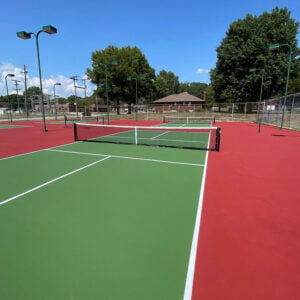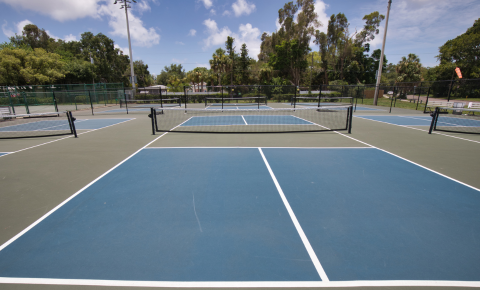
TYPTI and pickleball run on the identical court, the identical net, and often the identical membership base. For facility owners weighing a TYPTI vs. pickleball decision for their clubs, the court itself isn’t where the two sports separate. The equipment, the rules, and the programming math are. Full replacement of pickleball rarely makes sense yet. Adding TYPTI as a second bookable activity on courts you already own is the move most clubs are actually making in 2026.
Same Footprint, Different Sport
Ask whether you need a TYPTI court or a pickleball court and you’re asking the wrong question. There isn’t a separate TYPTI court. TYPTI runs on a standard 20-foot-by-44-foot pickleball court, with the same 36-inch sideline net height and 34-inch center height. USA Pickleball’s playing-area standards, 30 by 60 feet minimum and 34 by 64 feet for tournament play, cover TYPTI too, because the sport was built to sit inside existing pickleball infrastructure rather than compete with it for space.
That’s a deliberate choice by TYPTI’s creator, Steve Bellamy, founder of the Tennis Channel. Backed by investors including Drew Brees, Tony Robbins, and Chris Pine, TYPTI launched in January 2026 at California Smash, an indoor pickleball and social club in El Segundo, California. The sport wasn’t designed to win territory from pickleball. It was designed to occupy territory pickleball had already built.
If you haven’t checked whether your specific courts qualify, our TYPTI court readiness guide covers the full inspection checklist.
Where the Sports Actually Diverge
Short version: everything above the concrete.
Pickleball uses a solid paddle and a perforated plastic ball. TYPTI swaps in a 22-inch strung racket and a 3.5-inch channeled foam ball, closer in spirit to a junior tennis frame than anything currently on a pickleball court. That strung racket lets players generate spin a flat paddle face simply can’t produce, and the foam ball behaves differently off the strings than plastic does off composite.
The rule differences run deeper than equipment. Pickleball’s non-volley zone, the kitchen, doesn’t exist in TYPTI. Players can volley from anywhere on the court, including a step from the net. If a shot clips the net on your side and hasn’t bounced twice, the point stays alive, and you can redirect it with the racket, a hand, or a foot to keep the rally going. Serves must land below the belt, one attempt per point, no lets. Scoring runs on what TYPTI calls “the stakes”: three points in a row wins the game, and if a player leading 2-0 drops the next point, the right to close it out transfers to their opponent, even from zero. It’s a system built for momentum swings, not steady accumulation.
Why does that matter to an owner who isn’t the one on the court? Because the pace and unpredictability are what pull in players who’ve aged out of pickleball’s dinking rhythm, or never warmed to it in the first place. A faster sport that rewards streaks fills a different appetite than the one already on your schedule.
Noise, Briefly
TYPTI’s foam ball produces close to no sound on contact. Pickleball’s plastic-on-composite pop is the single most common driver of formal noise complaints against pickleball facilities nationally. We’ve broken down the acoustic difference in detail, along with what it means for HOA and municipal pressure, in our pickleball noise complaints guide. If noise is the reason you’re considering a switch rather than an addition, start there.
Surface Wear: What Changes When Two Sports Share a Court
TYPTI’s foam ball bounces at a noticeably steeper angle than a standard pickleball. That steep bounce exposes surface flaws a pickleball simply skates past. A birdbath that collects water after rain won’t just sit there looking bad. It produces a soft, dead bounce right where a player expects a clean pop, and they notice the first time they land in that spot.
Foot traffic patterns shift too. Pickleball concentrates wear in a narrow band behind the kitchen line, since players dink and reset close to the net. TYPTI has no kitchen, so players charge from deeper court positions and spread wear more broadly across the surface. Across 25+ states, we’ve walked courts that played fine for pickleball and still needed crack repair before we’d sign off on them for a sport with a steeper ball bounce. On a court with meaningful cracking, our repair crews can spend days working before any acrylic goes down, since the ARMOR Crack Repair System installs at roughly 300 linear feet per day. That timeline surprises owners who assumed a quick patch job. Across 1,000+ completed projects, the pattern holds: facilities that check surface condition before adding a second sport skip the member complaints that show up after they don’t.
The Business Case: Adding vs. Replacing
Here’s the math worth sitting with. TYPTI runs on largely the same revenue model as pickleball: court rental, open-play fees, league fees, and lesson pricing. It doesn’t create a new revenue category. It fills existing court-hours with a second bookable activity, mostly at price points you already charge.
That overlap is exactly why full replacement is premature for most clubs. Pickleball’s player base, equipment supply, and organized competitive structure are years ahead of TYPTI’s. TYPTI is still building its tournament circuit and its member base one demo day at a time. Clubs that pull pickleball programming entirely to bet on TYPTI are trading a proven draw for an unproven one, on the same courts, with no construction savings either way. Our guide to hosting TYPTI at your club walks through equipment costs and the programming formats clubs are actually running, if you’re past the comparison stage and ready to set a schedule.
For most clubs, the answer is both. Run both. Slot TYPTI into off-peak hours pickleball isn’t using, and let member demand, not a single launch event, decide how the schedule splits going forward.
Switching Your Club from Pickleball to TYPTI: A Decision Framework
Full replacement makes sense in a narrow set of cases: a facility under active noise litigation or an HOA ultimatum where pickleball’s sound profile is the specific, documented problem, or a club with real excess court capacity and a membership actively asking for something new. Outside those cases, switching entirely is a bet most clubs don’t need to make yet.
Honest answer: the clubs getting this right aren’t choosing one sport over the other. They’re treating it as a scheduling decision more than an identity one. Open play comes first, since it asks nothing of your court calendar beyond a label. Ladder leagues come next, once you’ve got enough regular players to fill a bracket. A demo day, marketed to the pickleball and tennis members already walking through your door, does more than any outside advertising will.
TYPTI can still become the primary sport on a given court. Some facilities, particularly ones in noise-sensitive residential zones, are already positioning TYPTI as the default option on the courts closest to property lines while keeping pickleball on courts farther from neighbors. That’s a targeted switch on specific courts. It’s a very different decision than dropping pickleball programming club-wide.
How do you know which category your club falls into? A written assessment of court condition, demand, and noise exposure answers that with facts instead of a guess.
Getting Your Courts Ready for Either Sport
“You have to figure out what do they need, what do they want, and what is the pain associated with whatever the problem is.”
Lance Laurent, President, Pro Track & Tennis
That question sits underneath every TYPTI decision a facility makes, whether it’s adding a single court block or weighing a full switch.
Pro Track & Tennis provides written surface assessments for pickleball court construction and conversion and multi-purpose court surfacing across 25+ states. In-house crews on every project, no subcontracting, with 30+ years and 1,000+ completed projects behind the assessment process. Call 800-498-4395 or email info@protrackandtennis.com to schedule one.
FAQs
Is a TYPTI court different from a pickleball court?
No. TYPTI runs on a standard 20-by-44-foot pickleball court with the same net height and line markings. If you already operate pickleball courts, you already have TYPTI infrastructure.
What’s the biggest gameplay difference between TYPTI and pickleball?
The absence of a kitchen. TYPTI has no non-volley zone, so players can volley from anywhere, including right at the net. Combined with the strung racket and foam ball, that produces a faster, more aggressive style than pickleball’s dinking game.
Should our club replace pickleball with TYPTI?
For most clubs, not yet. TYPTI’s player base and competitive structure are still developing while pickleball’s are established. Running both, with TYPTI filling off-peak court-hours, is the lower-risk path most facilities are taking in 2026.
Does adding TYPTI require resurfacing our courts?
Not automatically. A court in good condition for pickleball is usually ready for TYPTI. Courts with cracking, birdbaths, or worn acrylic should be checked first, since TYPTI’s steeper ball bounce exposes those flaws more readily than pickleball does.
Is TYPTI actually quieter than pickleball?
Yes. The foam ball and strung racket produce close to no contact noise compared with pickleball’s plastic-on-composite pop, which is the leading driver of formal noise complaints against pickleball facilities.
How do we decide which courts get TYPTI programming first?
Start with courts nearest noise-sensitive property lines if noise is a factor, and courts with the most off-peak availability if it isn’t. A written surface assessment can confirm which courts are ready before you commit to a schedule.
Next Step
If you’re not sure whether your courts qualify for TYPTI as-is, or whether a full switch or an add-on makes more sense for your facility, a written assessment settles it. Call 800-498-4395 or email info@protrackandtennis.com to schedule one across our 25+ state service area.