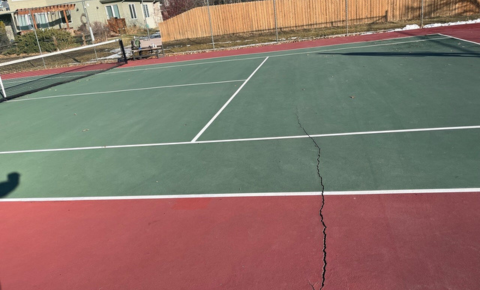
The short answer: If your resurfaced tennis court cracked again in the same spot, the resurface did not fail. The base underneath it did. A crack that starts in the asphalt or concrete slab does not disappear because you coated over it. It moves with the base, and when nothing interrupts that movement, the old crack works its way back up through the new surface. Contractors call this reflective cracking, and it is why a court can look flawless in spring and show the same line by the next season. Stopping it is possible, but it means treating how the crack moves instead of hiding it under fresh coating.
This piece is about that one gap: why reflective cracking happens, and why it can undermine a full resurface just as easily as a cheap patch. For the complete menu of repair options and what each one costs, our tennis court crack repair guide already covers that ground. This one is about the why behind a court that keeps re-cracking after real money went into fixing it.
What’s Actually Moving Under the Surface
A tennis court is layers. Acrylic coating on top, an asphalt or concrete base below, compacted stone under that, soil at the bottom. The coating is maybe an eighth of an inch of the whole system, and it carries almost no structural load. It gives you color, grip, and a true bounce. Everything holding the court flat sits below it.
Cracks start below the surface, in the base itself. Temperature cycling, freeze-thaw expansion, and base settlement all fatigue the asphalt or concrete from underneath, and none of that shows up as a coating problem first. It shows up as a base problem that the coating eventually has to deal with.
The American Sports Builders Association’s position paper on asphalt court cracking is direct about this: every repair method adds life to a court, but if you want a long-term fix, reconstruction is what it recommends, because that is what actually resets the base causing the crack. It is the honest baseline for planning, and it is the reason a resurface alone is never automatically a permanent fix.
Why Patching the Surface Doesn’t Hold
The cheapest repair usually fails first because it treats what’s visible. What actually decides whether a fix holds sits below, out of sight, in the base. The filler is rigid. The slab underneath is still moving. The next hot spell, the next freeze, and the base flexes right through the patch. Our crack repair guide breaks down the full repair menu and what each option costs.
That same mechanism is what makes reflective cracking possible even after a full resurface.
Reflective Cracking: Why Even a Resurface Can Telegraph the Old Crack
This is the part most articles about court cracks skip, and it is the one that catches facilities off guard.
You would think a full resurface solves the problem. New coating, fresh lines, clean start. Often it does exactly that. But if the crack in the base is active and nothing was done to interrupt it, the new surface can telegraph the old crack right back through. Contractors call this reflective cracking: the flaw in the layer below reflects up into the layer above, tracing the same line. ASBA’s own position paper on court cracking defines it almost the same way, as “reflection cracks (which occur in asphalt surface overlays and mirror a crack pattern in the pavement underneath).”
Why does a brand-new surface fail this way when nothing about the coating itself was wrong? Because the coating was never the thing holding the crack together. It was resting on top of a base that was still moving, and no acrylic system is designed to bridge that kind of ongoing movement on its own.
That is the real difference between a resurface that lasts and one that disappoints: what happened to the crack before the coating went down. A tennis court resurfacing laid over an untreated, moving crack is a countdown toward the same crack reappearing. We’ve walked onto courts where a client had already paid for one full resurface, watched the same hairline reappear within a season, and assumed the contractor did something wrong. Usually nobody did. The base was never treated first.
How to Tell If You’re Looking at Reflective Cracking
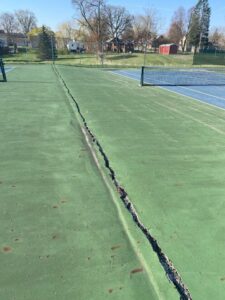
The signal is repeatability and placement. A crack that shows up in the exact same location it occupied before the resurface, tracing the identical line, is the base telling you it is still moving underneath. A random new hairline somewhere else on the court is a different, usually less urgent, problem.
What Actually Slows the Cycle
You cannot end cracking on an existing slab, full stop. Slowing it takes a repair built to move with the crack instead of fighting it.
That is the logic behind the ARMOR Crack Repair System, which is what our crews use on courts with real cracking. ARMOR is a flexible membrane system designed to move with the crack rather than pack it rigid. When the base moves, the membrane is built to absorb that movement instead of forcing it straight back up to the surface as a clean split. On courts, ARMOR carries a five-year warranty.
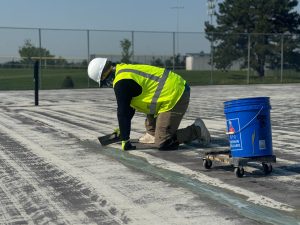
It is not instant. On a court with significant cracking, ARMOR advances at roughly 300 linear feet per day, so a heavily cracked court can mean days of crack work before any color coat goes on. We’ve seen crack work alone stretch across several days on a badly cracked court, before the crew ever touches the first color coat. That is the trade. Real crack work takes real time, and a bid that skips it to look cheaper is skipping the exact step that makes the surface last.
Here’s the honest limit: a membrane system buys years. On a stable base with isolated cracks, it can hold a long time. On a base that is genuinely failing, it is delaying a rebuild. Sometimes that is the smart financial call. Sometimes it is throwing good money after bad. Which one it is depends on the base.
When Repair Stops Making Sense
There is a point where no membrane, no resurface, and no amount of careful crack work gets you there. The base is too far gone. Lance Laurent, who has run this work for 30+ years, draws the line like this:
“Our niche is repairing existing courts and we’re really good at it. To be completely beyond repair, it would be a condition where the asphalt was really crumbling apart and there’s no way to really prep it. Our coatings would fail within weeks or a couple months. That’s the determination. We can make something that looks horrible look really good and playable, and breathe life into it. But if it’s breaking down to the point where our products won’t even stick, that’s when it determines that you have to tear it out and rebuild it.”
Lance Laurent, President, Pro Track & Tennis
One recurrence in the same place is worth watching. A pattern is a message, and it usually points at the repair-versus-rebuild decision. If you’re still in repair territory, that’s exactly what our crack repair guide walks through, including the repair menu and what each option costs.
How to Tell Which Situation You’re In
You can’t diagnose this from the parking lot, and you shouldn’t try.
Lean toward repair when the cracks are isolated and thin, the surface feels firm underfoot, and water drains off within a day of rain.
Lean toward a bigger conversation when cracks run in networks or trace the same lines you have fixed or resurfaced before, sections feel soft or hollow when you walk them, water pools in birdbaths that never fully dry, or the base is visibly crumbling at the edges.
What settles it is a written assessment. When our crews evaluate a court, they read the base: where water sits, how the cracks pattern, whether the asphalt still holds together, how much movement is left in the slab. Across 1,000+ completed projects, the courts that get an honest read before the contract is signed are the ones that don’t get surprised later.
Frequently Asked Questions
What is reflective cracking?
Reflective cracking is when a crack in a lower layer works its way up and reappears in a new surface directly above it. On a tennis court, an active crack in the asphalt base can telegraph through a fresh coating, or even a full resurface, if it was not interrupted first. It is the main reason a resurfaced court can show old crack lines within a season or two.
Why did my resurfaced tennis court crack again?
Because the crack originates in the base. A resurface only treats what’s on top. If the crack below was still active when the new surface went down, it works its way back up through the coating over time, tracing the same line it followed before. That’s reflective cracking, not a defect in the new surface itself. Stopping it means treating how the crack moves, with a flexible membrane system, before you resurface.
Can crack repair ever be permanent?
Not on an existing slab, according to ASBA’s own position paper on asphalt court cracking. Every repair method adds life to the court, but reconstruction is what the paper recommends for a genuine long-term fix, since that’s what replaces the base actually causing the crack. A quality membrane repair like ARMOR is about slowing the cycle and buying time. That’s often the smarter economic call, even though it doesn’t eliminate the crack forever.
How do I know if I need a repair or a full rebuild?
It comes down to the base. Isolated cracks on a firm, well-draining court point to repair. Networked cracks, soft or hollow spots, standing water, and cracks that keep returning in the same place point toward reconstruction. A written assessment is what tells you which side of the line you are on.
Does a warranty cover cracks coming back?
It depends on the term. A general workmanship warranty, which for Pro Track & Tennis runs two years, covers the installation itself. Base movement beneath it is outside any surface contractor’s control. ARMOR crack work on courts carries a separate five-year warranty. Get both terms in writing and ask what each one actually covers.
How long does professional crack repair take?
Longer than most people expect. ARMOR crack repair advances at roughly 300 linear feet per day, so a court with extensive cracking can need several days of crack work before any surface coating begins. That schedule is the point: the crack work is what makes the new surface hold.
Before You Resurface Over the Same Crack Again
If your court cracked again after a repair or a resurface and you’re not sure whether you’re looking at more crack work or a rebuild, that’s exactly what a written assessment is for. Pro Track & Tennis has completed 1,000+ court and track projects across 25+ states, all with in-house crews. Call 800-498-4395 or email info@protrackandtennis.com to set one up.