


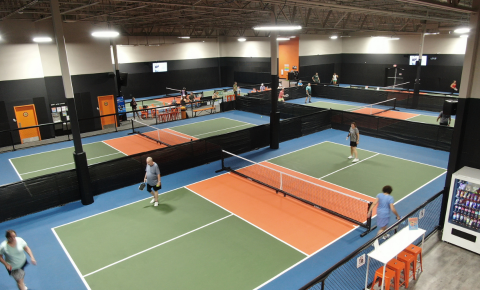
Most facility managers planning an indoor pickleball build assume they’re hiring one contractor. They’re not. Indoor pickleball court construction is two separate jobs: a general contractor for the building shell, and a surface contractor for the courts. Two contracts. Two different sets of decisions.
That second contract is where most facilities get into trouble.
This guide focuses on the surface side, which is where the variables hide and where the wrong call costs you later, often in ways that don’t show up until the third month after install. Court dimensions and ceiling clearance. Surface options and what drives their cost. Building-envelope considerations that affect surface work. How to pick the right surface partner once your GC is selected.
Indoor Pickleball Construction Is Two Jobs, Not One
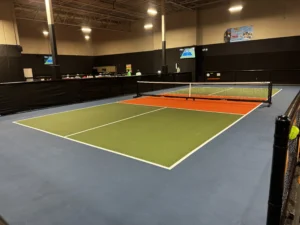
The building contractor handles the shell. Foundation, walls, ceiling, HVAC, lighting, framing. The surface contractor handles the courts. Slab prep, surface system, line work, finishing.
Most articles about indoor pickleball construction blur the line between these two scopes, writing as if one contractor does everything. In practice, that’s almost never how it works. Even contractors who can do both sides usually subcontract one half. The handful of operators in the space who genuinely do everything in-house are rare.
Why does the second contract cause more facility problems than the first? Because the variables hide there, not in the building shell. The shell is straightforward enough that a quality builder can deliver to spec. The surface is where the variables live. Slab condition. Moisture levels. Surface system compatibility. Line layout precision. These are the decisions that determine whether players love the court or complain about it.
Across 1,000+ projects, the most common indoor surface failure we see comes from one decision made early in the build: the GC pours the slab without coordinating with the surface contractor on moisture protocols or flatness tolerance. The slab looks fine to the eye. The acrylic goes down on schedule. Six months later, the surface telegraphs every defect underneath, and members start asking why the court feels uneven.
Here’s the sequence that prevents this: hire your GC first, they design and build the shell. Bring your surface contractor in before slab pour. They coordinate on flatness tolerance, moisture protocols, and drainage with the GC’s crew. Don’t wait until the building is complete to start surface conversations. A bad slab is the most expensive mistake to fix after the fact, and the cost of catching it before the pour is roughly zero.
Court Dimensions and Ceiling Clearance
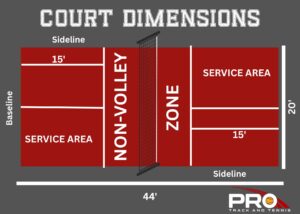
A regulation pickleball court measures 20 feet wide by 44 feet long. That’s the playing surface itself. You need more than that.
USA Pickleball recommends a minimum total playing area of 60 feet by 30 feet per court. That gives players enough buffer around the lines to move safely and play full points without colliding with walls or netting. For competitive or tournament-ready facilities, 64 feet by 34 feet is the preferred standard.
Ceiling clearance is the next variable.
The accepted minimum for indoor pickleball is 18 to 20 feet of overhead clearance. Lower ceilings create real problems with lob shots and overhead play, and they’re harder to retrofit than to spec correctly the first time. If you’re converting an existing building, ceiling height is the first thing to measure. Everything else flows from whether the height works.
Measure first.
Multi-court layouts require additional planning. Courts spaced too close together increase collision risk and reduce each court’s practical usability, because players from adjacent games end up in the wrong space at the wrong moment. USA Pickleball publishes minimum spacing standards between adjacent courts and between courts and walls. Check the current USAPA standards before finalizing your layout.
Surface Options for Indoor Pickleball
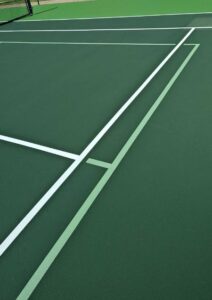
Which surface fits your facility? Honest answer: depends on the players.
Surface selection drives the player experience and the maintenance schedule. Get it right and the court stays playable for years. Get it wrong and you’ll resurface earlier than planned. Members will tell you about it.
The main options for indoor pickleball are concrete with acrylic coating, cushioned acrylic systems, sport-court tiles, and hardwood.
Concrete with acrylic coating is the most common indoor surface for new commercial facilities. A properly prepared concrete slab with a quality acrylic finish hands players a consistent surface they can rely on. Two things determine whether the system works: slab flatness and moisture control. Acrylic coating that goes down over an uneven or moisture-compromised slab will telegraph every defect for as long as the surface lasts. We’ve seen courts fail in year one because the slab wasn’t level enough at install. The eye can’t catch the variance. The ball does.
There’s another temperature constraint here. Acrylic coatings need a 60°F minimum on the surface and overnight, not just during the install. If overnight temperatures dip into the 50s during cure, the coating skin-cures wrong. You see it within a week, usually as a dull patch
on what should be a uniform finish. Indoor facilities solve this with climate control, but only if the HVAC actually holds temperature overnight rather than dropping to setback mode.
Cushioned acrylic systems add a rubberized layer under the acrylic coating. The result is a softer playing surface that’s easier on joints during long sessions. Pickleball draws a significant older-adult demographic, and that group pays attention to surface comfort. If your facility serves recreational players who spend hours on the court at a stretch, cushioned acrylic earns its premium over standard acrylic. Sport-court tiles (modular interlocking flooring) offer flexibility for facilities that need multi-purpose court surfacing capability. The tiles install and lift without permanent commitment. They’re faster to install than a poured surface. The trade-off is playing feel. Tiles play slightly differently than a poured surface, and the seams between tiles become a wear factor over time. Recreational use is fine. Tournament-level play is harder to justify on tile.
Hardwood surfaces show up in converted gymnasium spaces. They’re fine for pickleball play with appropriate line markings, but they need more maintenance than concrete acrylic and they’re sensitive to humidity. For facilities with existing wood gym floors, conversion is possible with the right surface treatment.
Lifespan on any indoor surface system depends on usage volume, maintenance schedule, and install quality. There’s no honest way to give a flat year-count without knowing those variables. A heavily-used commercial facility resurfaces sooner than a private club court. A well-maintained court outlasts a neglected one regardless of system.
What Drives the Surface Cost
Why can’t a contractor quote a firm price before evaluating your space? Because every slab is different, and they can’t read it from a desk.
The major variables:
Number of courts. More courts mean more surface area and more line work, but the per-court cost typically drops as the project scales up. A four-court build is usually more cost-efficient per court than a two-court build, because the crew is already on site and the surface system is already mixed.
Surface system. A basic acrylic finish on existing concrete costs significantly less than a cushioned acrylic system on a freshly poured slab. The gap between basic and premium options is substantial. Match the system to what your players actually need, not to the highest price tag. For most commercial indoor facilities serving recreational players, cushioned acrylic on a properly prepared slab is the right call. That’s the same surface system we apply on outdoor pickleball courts, where it’s the right call for institutional buyers who want a court their members will use hard for years.
Slab condition. This is the variable contractors can’t read from a desk. Concrete that needs grinding or moisture remediation before surface work can begin adds to the project scope. A physical assessment is the only honest way to know what the slab requires. We’ve quoted projects where the slab required weeks of moisture remediation before we could start surface work. We’ve also quoted projects where the slab was clean enough that surface install started the next morning. From outside the building, both projects looked identical.
Line work and finishes. Multi-court line layouts, color selections, and custom branding all factor into the final cost. They’re easy to underestimate when budgeting if you don’t price them in early.
Look: get itemized quotes. A proposal that hands you a single number without breaking down materials, surface preparation, labor, line work, and timeline tells you nothing. You have no basis for comparing it against anything
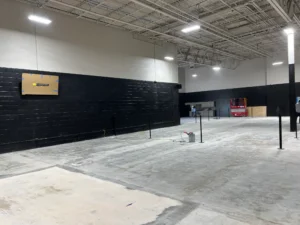
Building-Envelope Considerations That Affect Surface Work
Some building-envelope decisions affect the surface contractor’s ability to deliver a quality court. These are GC scope, not surface contractor scope. A surface partner who flags issues early in the design phase is worth listening to.
Lighting. Court lighting needs uniform illumination across the playing surface. Shadows and hot spots affect both gameplay and the facility’s perceived quality. LED systems are the standard for new builds. Work with a lighting designer who has done athletic court projects, not just general indoor lighting.
Acoustics. Pickleball is loud. The pop of the ball off the paddle is sharp and repetitive, and in a hard-walled indoor space, that sound bounces. Facilities that don’t address acoustics during construction end up with a noise environment that frustrates players and creates problems for adjacent spaces. Acoustic panels and ceiling treatments are functional infrastructure, not finish work.
We’ve toured indoor pickleball facilities where the noise alone is a complaint generator. Members in the lounge next door hear every paddle hit. Adjacent tenants in shared retail spaces complain to building management. The fix after the fact is more expensive than designing for it from the start.
HVAC. Temperature and humidity control affect both player comfort and surface longevity. High humidity causes acrylic surface systems to fail prematurely. Specify HVAC capacity that handles peak occupancy and accounts for the moisture players bring into the space. Remember the 60°F overnight floor requirement: if the HVAC drops to setback during off-hours and the surface is still curing, the coating suffers.
Slab flatness. This sits at the intersection of GC and surface scope. A slab that’s slightly out of level creates dead spots and inconsistent ball bounce. Verify the GC’s flatness tolerance before the pour. After the surface goes down, slab issues are expensive to correct.
How to Choose a Surface Contractor

What separates a quality surface contractor from a mediocre one? Two things: in-house crews and transparent proposals.
Surface contractor selection comes after your GC is in place but before the slab is poured.
Bring your surface partner in early. They need to coordinate on slab specs before pour, and the cost of involving them earlier rather than later is roughly zero.
Here’s what to look for.
ASBA membership. The American Sports Builders Association sets the standards for athletic surface construction. Working with an ASBA member means your contractor operates within an established framework for athletic surface quality. Ask first.
In-house crews. This matters more than it sounds.
“We use our own crews. Once you start subbing stuff out, you lose control.”
Lance Laurent, President, Pro Track & Tennis
When a surface contractor uses subcontractors for the actual install, accountability gets fragmented. Problems on the job turn into disputes between the contractor and the sub, and the facility manager is caught in the middle. An in-house crew means one point of contact and consistent quality from start to finish.
Relevant indoor experience. Indoor surfacing has its own variables. Slab moisture control. Lighting integration. Climate-controlled cure conditions. Ask the contractor to show completed indoor pickleball or tennis court resurfacing projects specifically.
Transparent proposals. A quality contractor hands you a written scope that breaks out materials, prep work, timeline, and warranty terms. If a proposal is vague about what’s included or excludes prep work from the line items, that’s a negotiating problem, not a starting point.
References. Ask for facility managers at comparable projects, and actually call them. Find out whether the contractor showed up on schedule, communicated clearly, and stood behind the work after completion.
Working With Pro Track & Tennis on Indoor Pickleball Surfacing
Pro Track & Tennis has been building and resurfacing athletic surfaces for more than 30 years, with 1,000+ completed projects across 25+ states and ASBA membership. The primary scope is outdoor. Tennis court resurfacing, outdoor pickleball court construction and conversion, running track resurfacing, multi-purpose court surfacing.
We’ve been doing this for three decades. The surfaces evolve. The fundamentals don’t.
For facilities planning indoor pickleball builds, Pro Track & Tennis operates as the surface contractor on the back end of a larger construction project. The general contractor handles the building. PTT handles the courts: slab prep, surface system application, line work, final finishing.
The crew is in-house on every project. No subcontracting, no handoffs.
Every project starts with a physical assessment. We walk your space and evaluate the slab condition before producing a written plan with realistic scope and costs.
If you’re planning an indoor pickleball facility and need a surface contractor who’ll be straight with you about what we can and can’t do, we’re ready to talk.
Call us at 800-498-4395 or email info@protrackandtennis.com to schedule a free facility assessment. We’ll walk the space and produce a clear surface-side plan you can take to your GC.
Frequently Asked Questions
What does indoor pickleball court construction actually cost?
It depends. That’s the honest answer most facility managers don’t want to hear. Industry sources cite wide ranges for total indoor builds, but those numbers include building-envelope costs that aren’t surface contractor scope. The surface side has its own variables: slab condition, system selection, court count. A surface contractor can only quote properly after evaluating the actual conditions.
How long does an indoor pickleball court surface last?
Lifespan depends on usage volume, maintenance schedule, and install quality. There’s no honest flat number. We’ve seen older courts that still play like new. We’ve also seen relatively new courts that need replacement. The variance comes from how the court is used and how consistently it’s maintained.
Can I convert my existing gym into a pickleball facility?
Often yes. The real question is whether your existing building meets the dimensional and acoustic requirements for pickleball-specific use. Verify ceiling clearance first. Then assess the slab. Check HVAC capacity and acoustics.
Do I need a general contractor and a surface contractor separately?
Almost always. The building envelope and the court surface are two different specialties. Finding one contractor who excels at both is rare. Hire your GC first. Bring your surface contractor in before slab pour.
What surface should I choose for indoor pickleball?
Concrete with acrylic coating is the most common indoor choice. Cushioned acrylic costs more but is easier on players who spend hours on the court at a stretch. Sport-court tile is the most flexible option if the space needs multi-use capability. Match the surface to the players, not the budget headroom.
When should I bring in a surface contractor?
After your GC is selected and design is locked, but before the slab is poured. The surface contractor needs to specify or verify the slab requirements upfront. Bringing them in after the building is complete is the most common mistake. Also the most expensive one to correct.