
Running Track Resurfacing
Running Track Resurfacing Cost: What to Expect and How to Budget
Updated on
·
5 min read

Published by

Key Takeaways
A structural spray and restriping on an average 8-lane track costs approximately $120,000.
A full scrape and new mat runs $200,000 to $300,000.
Minor crack repair with the ARMOR Crack Repair System runs $20,000 to $40,000, depending on the linear footage of cracks.
Track resurfacing takes 2-4 weeks.
A structural spray lasts 5-7 years if the maintenance coatings get done.
A worn running track gets more expensive to fix the longer it waits.
Resurfacing an average 8-lane running track costs approximately $120,000 to $300,000, depending on condition and scope. A structural spray costs approximately $120,000, while a full scrape and new mat runs $200,000 to $300,000. Division I university-level work can reach $700,000 to $1,000,000 or more.
At a Glance: Running track resurfacing costs approximately $120,000 to $300,000. Done on schedule, resurfacing maintains performance and safety. Wait too long, and base damage may require a complete rebuild at significantly higher cost.
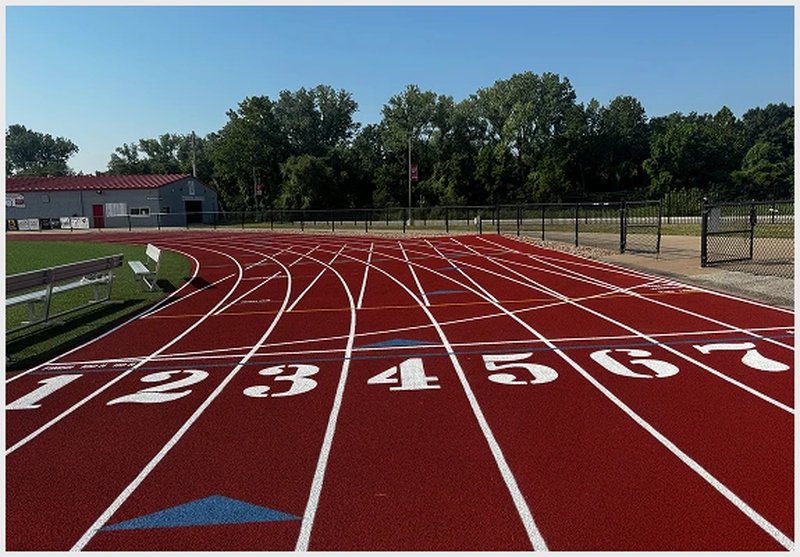
Pro Track & Tennis serves 25+ states across the Midwest, South, and Mountain West, resurfacing and rebuilding tracks for school districts and universities.
We help facilities decide what their track actually needs and when to act before the base fails.
What “Resurfacing” Really Means (and Why Timing Matters)
Resurfacing isn’t rebuilding. It’s a structural refresh: repairing cracks and applying new coatings to renew traction and color. The asphalt base stays intact, saving both time and money.
“A running track can be pretty wore out, but you can patch it, you can patch the cracks, and you can do what they call a structural spray. It’s like repainting your house. You’re repainting it, but you’re adding rubber to the paint coating.”
Lance Laurent, President, Pro Track & Tennis
When done on time, resurfacing is a predictable cost. Delay too long, and moisture can get into the base, causing heaving or delamination, and what would have been an approximately $120,000 structural spray becomes a much larger expense.
Waiting adds cost. A track that qualifies for a structural spray at approximately $120,000 today can need a full scrape and new mat at $200,000 to $300,000 later.
Average Running Track Resurfacing Cost by Type
Here’s the math on an average 8-lane track:
Surface System | Typical Cost (average 8-lane track) | Notes |
|---|---|---|
Minor crack repair | $20,000-$40,000 | ARMOR Crack Repair System (cost depends on linear footage of cracks) |
Structural spray | ~$120,000 | Recoating and restriping all lines |
Full scrape and new mat | $200,000-$300,000 | Complete removal of old surface, new rubber system |
Premium systems | $300,000-$700,000 | High-performance surface systems |
Division I systems | $700,000-$1,000,000+ | Division I university-level surfaces |
We’ve quoted tracks where a structural spray at approximately $120,000 was enough, and tracks where the old mat had to be scraped off and replaced at $200,000 to $300,000.

What Drives Running Track Resurfacing Cost
Every running track resurfacing project begins with a professional inspection. Base condition and drainage drive the final price, and climate decides when the work can happen.
1. Existing Surface Condition
Worn surface on a sound base = structural spray and restriping (approximately $120,000), plus crack repair where needed
Widespread cracking = extensive prep work
Base movement or trapped moisture = major repairs needed
A mat worn past what a spray can fix = full scrape and new mat ($200,000 to $300,000)
2. Material Type and System
The table above prices each tier. For the surface itself, we work with Polysport (formerly Conica), our track surface partner, and with Nova Sports track systems.
3. Regional Climate
Your local weather affects installation timing. Coatings can’t go down below 60°F or on damp surfaces, so northern states get a much shorter work window, mainly summer.
4. Drainage and Base Integrity
Poor drainage can cause track failure. Standing water inside turns or along lane lines points to slope problems. The industry calls these low spots birdbaths. Have them checked at the free on-site assessment, before any coating goes down.
5. Crack Repair Systems
Crack repair gets priced as its own line. What moves that number? The linear footage of cracks. On a track, minor crack repair with the ARMOR Crack Repair System runs $20,000 to $40,000. Our crews install ARMOR at about 300 linear feet per day, so a badly cracked track can take days of repair before any coating goes down. That work comes first, then the structural spray or the new mat. Ask every contractor to show crack repair as a separate line so you can compare like with like.

Resurface or Rebuild? How to Tell
Resurface if:
Water drains off after rain instead of ponding
Cracks are surface-level only
The base feels firm and level
No bubbling or soft spots appear
Ask about a rebuild if:
The surface feels spongy or uneven
Water stands on the track long after rain
The asphalt base has deep structural cracks
Entire sections have lifted or separated
Only a look at the base on site can settle it, and the assessment is free.
Inside a Professional Resurfacing Project
A standard 400-meter resurfacing project takes 2-4 weeks, depending on weather. Why a range? Weather and the amount of crack repair both move it.
Typical scope:
Crack repair with the ARMOR Crack Repair System where needed
A structural spray and restriping, or a full scrape and new mat when the old mat is worn out
All work done by our in-house crews, with no subcontractors
A 2-year general workmanship warranty
See a finished track in our Ulysses High School track project.

How to Get a Reliable Quote
A professional quote should show what you’re buying. Can you match each line to work on your track? If not, ask before you sign.
Before signing, confirm it includes:
Surface and base report with documentation
Material specifications and layer thickness
Warranty details on labor and materials
Proof of in-house crews (not subcontractors)
If you’re still evaluating companies, read our guide on how to choose a running track contractor to compare proposals and check credentials before you make your decision.
Pro Track & Tennis uses 100% in-house crews, with no subcontracting. See what to expect when you work with Pro Track & Tennis.
How to Extend Track Life After Resurfacing
Resurfacing resets performance. Maintenance protects it.
A structural spray lasts 5-7 years if the maintenance coatings get done. A new mat can last upwards of 20 years if the maintenance coatings are done every five to seven years. A professional evaluation can determine timing.
Routine care:
Avoid dragging hurdles or carts across lanes
Keep drains clear and grass trimmed

Running Track Resurfacing Cost FAQs
How much does it cost to resurface a running track?
A structural spray and restriping costs approximately $120,000 on an average 8-lane track. A full scrape and new mat costs $200,000 to $300,000.
What does track crack repair cost?
Minor crack repair with the ARMOR Crack Repair System costs $20,000 to $40,000, depending on the linear footage of cracks.
How long does track resurfacing take?
Track resurfacing takes 2-4 weeks. In northern states the work window is much shorter, mainly summer, because coatings can’t go down below 60°F.
How long does a resurfaced track last?
It depends on the system and the upkeep. A structural spray lasts 5-7 years if the maintenance coatings get done. A new mat can last upwards of 20 years if the maintenance coatings are done every five to seven years.
What warranty comes with the work?
Pro Track & Tennis gives a 2-year general workmanship warranty. On jobs bid through a general contractor or architect, the warranty follows the project spec.
The Bottom Line
Running track resurfacing cost depends on track size, the surface system, base condition, and timing. Timing is the one you control: a structural spray caught early runs approximately $120,000, and the same track left too long can need a full scrape and new mat.
Plan the resurface before the base fails, and hire a contractor whose own crews do the work.
Book early. A free on-site assessment before the next athletic season leaves time to fit the work into the warm-weather window.
Pro Track & Tennis: 1,000+ projects across 25+ states, with in-house crews. Call 800-498-4395 or email info@protrackandtennis.com.
Get a Free Assessment for Your Court or Track
Our in-house crews have completed 1,000+ projects across 25+ states. Tell us about your facility and we will inspect the surface and give you a straight plan and quote.
Get Free Assessment
»
About the Author
Marketing Manager, Pro Track & Tennis
Recent Blog Posts
Discover More →
•
8 min read
Plan your fall court and track resurfacing project: when to book, how budget cycles fit in, and how to sequence multiple surfaces.
•
8 min read
Your tennis court cracked again after resurfacing? Learn why reflective cracking happens and what actually stops an old crack from reappearing.
•
7 min read
Learn how tennis court resurfacing timing affects downtime, from weather windows to phasing multi-court facilities without closing everything at once.
•
7 min read
TYPTI vs. pickleball for clubs: court, equipment, and rules differences, plus a decision framework on adding TYPTI or switching entirely.
•
10 min read
How to host TYPTI at your club: equipment, court readiness, programming, marketing, and the revenue model, compared to pickleball benchmarks.