
Running Track Resurfacing
Running Track Standards: A Facility Manager’s Guide to Design, Dimensions, and Compliance
Updated on
·
13 min read

Published by

Key Takeaways
A standard outdoor competition track measures 400 meters in Lane 1, with lanes typically 1.22 meters (4 feet) wide and most high school facilities using 6-8 lanes.
NFHS and World Athletics standards define track geometry, lane markings, surface systems, and drainage requirements.
Most track failures originate from poor base construction or inadequate drainage, not from worn surfaces.
Track lifespan varies based on surface system, climate, and maintenance schedule. A structural spray with regular maintenance coatings performs very differently than a new full mat system.
Getting the base and drainage right matters more than any surface you put on top of it. Most facilities don’t know what they have until a contractor walks the track.
Early consultation with an experienced contractor helps schools avoid geometry issues, drainage failures, and costly reconstruction later

Introduction: Why Running Track Standards Matter for Schools
Running track standards exist for a simple reason: consistency. When athletes compete at different facilities, the distance must be the same everywhere. A 400-meter race at one school should measure exactly the same as a 400-meter race at another.
But compliance isn’t just about fairness in competition. For facility managers and athletic directors, track standards also affect safety, long-term maintenance costs, and the ability to host sanctioned meets.
Many schools focus on the visible parts of the facility — lane markings, surface color, or the number of lanes. In reality, the most expensive problems usually begin beneath the surface. Poor base construction, drainage issues, or inaccurate geometry can shorten the life of a track dramatically.
Understanding both regulation dimensions and construction standards helps facility leaders make smarter decisions when planning new tracks or evaluating resurfacing projects.
This guide explains the dimensions, construction standards, and maintenance practices that protect both athletes and long-term facility budgets. It’s written from the perspective of a contractor that has completed 1,000+ track and court projects across 25+ states — so the guidance here reflects what we’ve actually seen in the field, not just what the rulebook says.
The Standard Running Track Length and Layout
The 400-Meter Standard
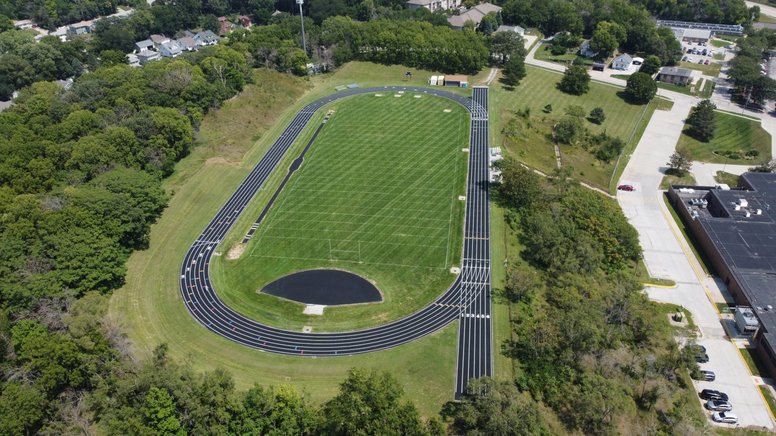
Most outdoor running tracks follow the 400-meter standard, measured along a specific reference line in Lane 1. This design is used worldwide and forms the basis for track and field competition at every level.
For most high school facilities, the standard layout includes:
Track Element | Standard Measurement |
|---|---|
Track length | 400 meters |
Lane width | 1.22 m (4 ft) |
Number of lanes | Typically 6-8 |
These dimensions align with both NFHS high school standards and international guidelines established by World Athletics. Using these standards ensures that performances recorded at one facility can be compared fairly with performances at another.
Lane 1, the innermost lane, is precisely 400 meters in circumference. Accurate measurement of Lane 1 is the foundation for all stagger calculations and official race timing.
Track Geometry
A standard running track is not a perfect oval or circle. It consists of two straight sections connected by two semicircular curves.
Typical geometry includes:
Two straights of approximately 84 meters
Two semicircular curves with a radius of about 36.5 meters
A symmetrical layout ensuring equal competition conditions
These measurements are carefully calculated. Even small variations in curve radius can affect lane stagger calculations and athlete fairness.
This is worth understanding because when tracks are resurfaced repeatedly without careful surveying, geometry drift accumulates. By the third or fourth resurface, some tracks are measurably off — which creates compliance issues when hosting sanctioned meets.

Lane Width, Lane Count, and Safety Zones
Standard Lane Width
Standard lane width is 1.22 meters (4 feet). Lane markings themselves are 5 centimeters wide and count as part of the lane width.
This dimension provides enough space for athletes to compete safely while allowing multiple lanes to fit within the available facility footprint.
During resurfacing, contractors must verify that lane widths remain consistent. Slight shifts in previous markings can accumulate over time if measurements are not checked carefully.
Lane Count Requirements
The number of lanes influences both competition capability and facility cost.
Configuration | Typical Use |
|---|---|
6 lanes | Smaller schools and practice facilities |
8 lanes | Most competition-ready high school tracks |
9 lanes | Championship or large collegiate venues |
For most high schools, eight lanes offer the best balance between competition capability and budget. Additional lanes increase construction costs but allow larger meets with multiple heats, greater scheduling flexibility, and more spectator capacity.
For budget planning purposes, the jump from six to eight lanes is meaningful in both construction cost and scheduling flexibility. Most high schools we work with land on eight lanes as the right balance. If you’re evaluating this for a new build, it’s worth talking through your meet hosting goals before committing to a lane count.
Track Markings and Measurement Standards
Lane markings are more than visual guides. They determine whether races are measured accurately and whether results can be officially recognized.
Measurement Reference Line
The official 400-meter measurement is taken along a reference line positioned near the inside boundary of Lane 1. The position depends on whether the track has a curb:
Condition | Measurement Reference |
|---|---|
Raised curb present | 30 cm from the inside curb |
No curb (painted line) | 20 cm from the line |
This distinction matters when resurfacing or modifying a track. Changing the inner boundary can shift the reference line and affect the total distance.
Lane Staggers
Because outer lanes follow a larger curve radius, they cover a longer distance. To compensate, staggered start lines are used so each runner completes the same distance.
On a typical 400-meter track, each outer lane adds roughly 7-8 meters per curve. Lane 8 can be more than 50 meters longer per lap than Lane 1 without stagger adjustments.
Accurate stagger placement requires survey-grade measurement during track construction and marking. This is one area where experience matters more than equipment. We’ve evaluated tracks where stagger errors had accumulated over multiple resurface cycles — by the time someone noticed, the correction required more than just repainting lines.

Governing Bodies That Define Running Track Standards
NFHS (High School Standards)
In the United States, most high school competitions follow National Federation of State High School Associations (NFHS) guidelines. These standards define lane dimensions, markings, event layouts, and equipment specifications.
World Athletics Standards
World Athletics (formerly the IAAF) publishes the global track facility manual used for international competition. Their standards include stricter measurement tolerances, certification requirements, and testing procedures for track surfaces. Most high school facilities follow NFHS rules but remain very similar to World Athletics standards.
Why Compliance Matters
Non-standard facilities can create real problems. Schools may face restrictions on hosting regional or state meets, invalid competition records, and expensive geometry corrections during resurfacing.
Schools that discover compliance issues during a meet — rather than during a contractor evaluation — typically face rushed, expensive corrections. A pre-project geometry check costs almost nothing in comparison. Verifying compliance early helps avoid these issues.

Running Track Construction Standards: The Part That Actually Determines Lifespan
Dimensions alone do not determine track quality. Construction standards beneath the surface are equally important. Many premature track failures occur because of inadequate base preparation or drainage issues rather than problems with the surface system.
This is why a contractor evaluation before resurfacing isn’t optional — it’s how you find out whether you’re looking at a surface project or a foundation project. Those are very different budgets.
Subgrade Preparation
The subgrade is the native soil beneath the track structure. Proper preparation requires soil compaction exceeding 95 percent density, consistent grading, and stabilization of weak soils. If the subgrade shifts, cracks and depressions eventually appear in the track surface.
Aggregate Base Layer
Above the subgrade sits a compacted stone base that provides structural support and drainage. Typical requirements include uniform thickness, proper compaction, and integration with drainage systems. If this layer settles unevenly, water begins collecting in low areas — what contractors call birdbaths.
Asphalt Base Course
The asphalt layer creates the smooth platform for the synthetic track surface. Specifications include strict smoothness tolerances and adequate curing time before surfacing. Asphalt thickness varies by region and sub-base conditions — a specialist contractor will determine the right depth for your site. Even the best synthetic materials will fail if applied over a poorly constructed asphalt base.
Installation and Quality Control
Quality control throughout construction matters as much as the specifications themselves. That includes regular inspections during base installation, verification of slope and drainage performance before the surface goes down, and final geometry checks before line striping. A contractor who skips these steps creates problems that won’t show up until years later.

Drainage Standards for Running Tracks
Drainage may be the most overlooked factor in track performance. When water cannot move away from the surface, several problems develop quickly: surface delamination, premature cracking, and traction loss.
Track Slope Standards
Running tracks require subtle slopes that direct water away without affecting athletes. World Athletics standards allow a maximum cross slope of 1 percent toward the infield, with a maximum longitudinal slope of 0.1 percent along the straights. These slopes are nearly invisible to runners but essential for drainage.
Common Drainage Failures
Facility managers often encounter birdbaths or standing water, base saturation beneath the surface, and early surface breakdown. Most premature track failures begin with water infiltration beneath the surface layers.
If you’re seeing standing water anywhere on your track — even in small areas — it’s worth getting an evaluation before you commit to a resurfacing budget. What looks like a surface problem is often a drainage problem that resurfacing won’t fix.
Not sure if your drainage is the issue? Pro Track & Tennis offers free track assessments for facility managers. Our team will walk your lanes, check slope and base conditions, and give you an honest picture of what you’re working with. Call 800-498-4395 or email info@protrackandtennis.com.
Synthetic Running Track Surface Standards
Modern running tracks use synthetic materials designed to provide consistent traction, durability, and athlete safety. Three primary surface systems are common.
Latex-Bound Rubber Systems
Latex-bound rubber tracks are widely used in school facilities because they are cost-effective. They offer lower installation cost, adequate performance for most school programs, and proven durability for moderate use. For most high school programs, a quality latex system with proper maintenance delivers strong value. Lifespan varies based on usage, climate, and how consistently maintenance coatings are applied.
Polyurethane Systems
Polyurethane tracks are considered premium competition surfaces. Advantages include higher durability, improved energy return, and greater resistance to weather and UV exposure. They are often used for championship venues and high-use facilities. Full-pour polyurethane is the standard for elite and Olympic-level competition, offering maximum energy return and durability.
The cost difference between a latex system and a polyurethane system is real, but so is the difference in durability and maintenance demands. For high-use facilities or championship venues, the premium is usually worth it.
Selecting the Right Surface
The right system depends on climate, usage levels, maintenance resources, and budget constraints. A contractor who works across multiple climate zones and surface types — rather than one who installs only one system — can give you a more objective recommendation.

Running Track Maintenance Standards
Track maintenance protects both safety and long-term investment.
Routine Maintenance
Basic tasks include debris removal, inspection for cracks or damage, edge vegetation control, and minor repairs. Regular maintenance prevents small issues from becoming major repairs. Annual walkthroughs are the best way to catch early signs of wear before they require significant intervention.
Surface Cleaning
Cleaning maintains traction and prevents buildup of dirt and organic material. Common methods include light pressure washing, gentle brushing, and periodic inspection of lane markings. Proper cleaning also helps preserve the visibility of track markings.
Resurfacing Timeline
Track lifespan varies based on the surface system, climate, and how consistently maintenance coatings are applied. A structural spray with regular maintenance coatings gives a different lifespan than a full new mat system. When in doubt, schedule a professional evaluation rather than relying on general timelines.
Signs resurfacing may be needed include fading or worn surface texture, visible cracks, inconsistent traction, and delamination of surface layers. Resurfacing before base damage develops significantly reduces project costs. The difference between resurfacing at the right time and waiting two extra seasons can be the difference between a $120,000 project and a $400,000+ rebuild.
Common Mistakes Schools Make When Building or Resurfacing Tracks
Several issues appear repeatedly in facility projects:
Prioritizing surface appearance instead of drainage
Skipping base inspection before resurfacing
Assuming old geometry is still correct
Selecting contractors based only on lowest price
Delaying resurfacing until structural damage occurs
That last point about contractor selection deserves a bit more attention. The lowest bid rarely accounts for base evaluation, drainage correction, or the cost of a callback if the surface fails early. A detailed written scope matters more than the bottom-line number.
Planning Running Track Projects for School Budgets
Track facilities follow predictable lifecycle stages. Understanding where you are in that cycle helps you plan proactively rather than reactively.
Maintenance Phase
Focus on establishing maintenance routines, documenting facility condition, and planning long-term budgets. Small investments in this phase pay off significantly later.
Resurfacing Window
A structural spray lasts 5 to 7 years if the maintenance coatings get done. During this phase, schools should evaluate resurfacing before surface wear becomes structural damage. Resurfacing often includes a new surface coating, lane marking updates, and minor geometry corrections.
This evaluation should include a physical inspection of the base, a drainage review, and a realistic cost comparison between resurfacing and reconstruction. Pro Track & Tennis provides this as a free assessment, and it gives facility managers the documentation they need to move a project through budget approval.
Reconstruction Evaluation
A new mat can last upwards of 20 years if the maintenance coatings are done every five to seven years. Older tracks may eventually require full reconstruction. Evaluation should consider base condition, drainage performance, compliance with current standards, and total lifecycle cost. Planning ahead prevents emergency repairs and budget surprises.
When to Bring in a Track Contractor
Consulting an experienced contractor early is often the most cost-effective step in track planning. The purpose of that early evaluation isn’t to sell you something — it’s to give you a clear picture of what you’re working with before you commit to a budget or a scope.
A professional evaluation can verify track geometry, inspect base and drainage systems, determine whether resurfacing or reconstruction is needed, and provide realistic cost estimates. Schools that get this done before the budget process moves forward are almost always in a better position than those who get surprised mid-project.
For facility managers trying to make the case internally for a track project, a written assessment from an experienced contractor gives you credible documentation — not just your own observations of visible wear.
Pro Track & Tennis — Serving 25+ states with 1,000+ completed projects. ASBA member company. In-house crews. Schedule a free track assessment and get a written evaluation with realistic costs and timelines. Call 800-498-4395 or email info@protrackandtennis.com.

Frequently Asked Questions About Running Track Standards
What are the standard dimensions of a running track?
A standard outdoor track measures 400 meters in Lane 1 and includes two straights of about 84 meters and two semicircular curves with a 36.5-meter radius. Indoor tracks have no official standard dimensions and vary based on available space.
How wide are track lanes?
Standard lane width is 1.22 meters (4 feet) including the lane marking line.
How long is a high school running track?
Most high school tracks follow the 400-meter standard, although some smaller campuses may use 300-meter layouts due to space limitations.
What standards must school tracks meet?
Most U.S. school tracks follow NFHS guidelines, which closely align with World Athletics specifications for dimensions, markings, and surfaces.
How do I know if my track needs resurfacing or full reconstruction?
If you’re seeing surface wear, fading, or fine cracks — but water still drains within 24 hours and the base feels firm underfoot — resurfacing is likely the right call. If you’re seeing standing water, cracks that go through the asphalt, soft or spongy areas, or surface that’s lifting or delaminating, you may be looking at reconstruction. The honest answer is that a professional evaluation is the only way to know for certain. We provide those at no cost.
How often should a running track be resurfaced?
Lifespan varies based on surface system, usage, and climate. A structural spray with consistent maintenance coatings performs differently than a full new mat system. Rather than relying on a general timeline, schedule a professional evaluation to assess your specific track’s condition.
Can a non-standard track host official meets?
Non-standard tracks may host local competitions but typically cannot host championship events or record-eligible races.
What types of events are held on a standard running track?
Standard tracks are used for sprints, middle-distance races, relays, hurdles, steeplechase, and field events. The steeplechase requires a permanent water jump pit measuring 3.66 meters by 3.66 meters, positioned inside or outside one of the curves.
How are track measurements verified?
Survey-grade equipment is standard, and advanced systems including LiDAR mapping are increasingly used to verify curve radii and lane-width consistency with greater precision than traditional manual tools.
Final Thoughts: Running Track Standards Protect Athletes and Budgets
Running track standards are about more than measurements. They ensure facilities remain safe, fair, and financially sustainable.
Accurate geometry, proper drainage, and strong base construction determine whether a track performs well for decades or begins failing within a few years. Most of that story is written before the surface ever goes down.
For facility managers and athletic directors, understanding these standards helps guide better decisions when planning construction, resurfacing, or long-term maintenance. The most effective approach is simple: evaluate existing conditions early, understand the full lifecycle of the facility, and plan improvements before problems become expensive.
If you’re not sure where your track stands, the most practical first step is a professional evaluation. Pro Track & Tennis offers free assessments for facility managers — our team will walk your track, inspect the base and drainage, and give you an honest picture of what you’re working with.
Pro Track & Tennis — 1,000+ projects completed. 25+ states served. ASBA member. In-house crews only. Call 800-498-4395 | Email: info@protrackandtennis.com | protrackandtennis.com
Get a Free Assessment for Your Court or Track
Our in-house crews have completed 1,000+ projects across 25+ states. Tell us about your facility and we will inspect the surface and give you a straight plan and quote.
Get Free Assessment
»
About the Author
Marketing Manager, Pro Track & Tennis
Recent Blog Posts
Discover More →
•
8 min read
Plan your fall court and track resurfacing project: when to book, how budget cycles fit in, and how to sequence multiple surfaces.
•
8 min read
Your tennis court cracked again after resurfacing? Learn why reflective cracking happens and what actually stops an old crack from reappearing.
•
7 min read
Learn how tennis court resurfacing timing affects downtime, from weather windows to phasing multi-court facilities without closing everything at once.
•
7 min read
TYPTI vs. pickleball for clubs: court, equipment, and rules differences, plus a decision framework on adding TYPTI or switching entirely.
•
10 min read
How to host TYPTI at your club: equipment, court readiness, programming, marketing, and the revenue model, compared to pickleball benchmarks.