



Most facilities don’t get burned by obviously unqualified contractors. They get burned by bids that look professional on paper and fall apart on court.
The failure mode is rarely outright fraud. More often it’s a contractor who prices accurately for what they’ve scoped, then scopes far less than the project actually demands. An RFP that doesn’t force specificity invites that kind of bid. A selection committee scoring primarily on price will choose it every time.
What to look for in a tennis court contractor RFP: confirmed site visits before bidding, written disclosure of subcontracting plans, itemized prep work costs separate from surface work, full warranty terms with exclusions listed, ASBA membership or equivalent credentials, and references from comparable project types. Any bid that can’t satisfy these requirements warrants closer examination before it advances.

What a Tennis Court Contractor RFP Should Cover
A well-written RFP does two things: it forces bidders to demonstrate their process, and it gives the selection committee a consistent basis for comparison.
At minimum, require:
- Confirmation that a site visit was completed before bid submission, with the visit date in writing
- A written declaration of whether subcontractors will be used and what work they’ll perform
- An itemized scope that separates surface work from prep work (crack repair, base correction, drainage)
- Full warranty terms: duration, what’s covered, what’s excluded
- Industry credentials or association membership (ASBA membership is the standard for sports surface work)
- References from comparable projects completed within the last five years
Leave any of these out and you hand the contractors who need them an escape hatch.
No Site Visit Before the Bid
This disqualifies a bid outright.
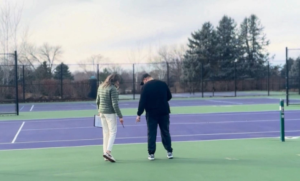
A court’s surface can look consistent in photos and hide a deteriorating base. A court with a base problem may feel soft underfoot in places and show nothing obvious from a distance or in aerial imagery. Drainage pitch, standing water patterns, and base softness don’t appear in submitted documents. A contractor quoting from site plans has priced for a court they’ve never evaluated.
How do you know if a visit happened? Require written confirmation of the visit date as a submission element. Any bid without it is non-responsive and can be disqualified. That’s standard in facilities construction procurement and entirely defensible to a board or committee.
What did they check when they got there? A surface contractor doing a real assessment will document drainage, cracking pattern, base condition, and the extent of any existing repairs. A contractor who “drove by” is a different thing entirely.
We’ve evaluated courts that looked sound from the parking lot and had drainage conditions that would have caused the new surface to fail within a season. The site visit is the only way to know what you’re actually pricing.
No Disclosure on Subcontracting
Subcontracting itself isn’t disqualifying. What matters is whether the contractor tells you about it up front.
A contractor who hands off surface application to an outside crew is giving up the most skill-sensitive part of the job. Quality control and accountability both get harder when a subcontractor enters the picture. Who owns the warranty resolution when the installing crew wasn’t the contractor’s own? That question gets complicated fast and tends to come up at the worst time.
“We use our own crews. Once you start subbing stuff out, you lose control.”
Lance Laurent, President, Pro Track & Tennis
The RFP should require bidders to identify any subcontractors and specify exactly what work they’ll perform. A contractor running in-house crews on every project should be able to say so without hesitation.
Pricing That Excludes Prep Work
This is where most tennis court project budgets break down.
A single tennis court resurfacing starts at $20,000 for local projects with no prep work required. Most courts that have reached the point of going out for bids aren’t in no-prep condition. Crack repair, drainage correction, and base patching each carry their own cost. A bid that quotes a flat resurfacing price without accounting for site conditions is either a low-ball number designed to win the contract and renegotiate scope later, or a contractor who didn’t assess carefully enough to know what the project actually requires.
What a credible bid includes: an itemized proposal that separates the surface system from preparatory work, with a written explanation of why each prep item is or isn’t needed. If the contractor visited and found no prep work required, that determination should appear explicitly in the bid, not be assumed from the absence of a line item.
Across 1,000+ completed projects, bids that generate post-award conflict almost always share the same structure: scope bundled into a single line item with definition left for later.
Vague or Absent Warranty Language
That’s the baseline. Two years for general workmanship.
What matters as much as duration is what’s excluded. Most workmanship warranties don’t cover base failures, drainage problems, or surface damage from extreme weather. That’s not bad faith: a surface contractor can’t control what’s below the surface they’re installing, and most warranties reflect that reality. The exclusions just need to be in writing.
A warranty that reads “we stand behind our work” is not a warranty term. It’s a sentence.
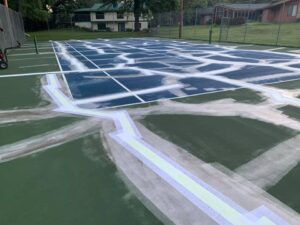
If crack repair is part of the project scope, ask whether the contractor is using the ARMOR Crack Repair System. ARMOR carries a 5-year warranty on courts, which is a documentable, separate term from the general workmanship coverage. On a court with significant cracking, ARMOR advances at roughly 300 linear feet per day, meaning extensive hairline cracking can require days of repair work before any surface coating begins. Get both warranty terms in writing and understand what each covers.
Missing Industry Credentials
ASBA membership is the most relevant credential for sports surface contractors in this market. The American Sports Builders Association sets technical standards for court and track construction, and a contractor who engages with those standards regularly will understand them far better than one who has never had reason to look.
A contractor who can’t name any industry affiliations is signaling something about their relationship to the standards that govern this work.
One point to clarify in the RFP: ASBA certifies individuals, not companies. The ASBA Certified Builder designation applies to specific project managers or crew leads, not to the company as a whole. If a contractor claims their company is “ASBA-certified,” they’re using the term loosely. Ask whether any of their project managers or crew leads hold the Certified Builder designation.
References from the Wrong Project Type
Ask for references and most contractors will give them. What are those references actually telling you about this project?
A portfolio of residential single-court installs looks different from institutional work for a school district, municipality, or country club. The scope, the accountability structure, and the surface systems in play are each different enough to matter. A contractor who has done strong work on home courts isn’t automatically prepared for a multi-court parks renovation on a compressed municipal timeline.
When collecting references, specify projects of similar court count, similar surface type (outdoor acrylic systems), and similar owner type, completed within the last five years. Three questions to ask on each reference call: Did the project finish on schedule? Did the final scope match the proposal? How did the contractor handle any issues after completion?
Those answers matter more than general satisfaction.
How to Weight the Evaluation
Look, price matters. It just shouldn’t be the only thing that does.
A weighted scoring framework gives the selection committee a defensible award basis when the lowest bid isn’t the right choice. A reasonable starting point:
| Criterion | Suggested Weight |
| Relevant experience and references | 35% |
| Scope clarity and completeness | 25% |
| Pricing and value | 25% |
| Warranty terms | 10% |
| Industry credentials | 5% |
Institutions with formal procurement requirements may need to adjust these weights. The principle stays constant: a contractor whose only differentiator is a lower number has told you exactly where the savings are coming from.
Getting a Baseline Before the RFP Goes Out
There’s a step worth taking before the formal RFP is drafted: request written assessments from one to three pre-qualified contractors.
A written assessment documents existing court conditions, identifies the prep work the project actually requires, and gives your committee a baseline for comparing what each bidder finds on site. If three contractors submit assessments and one identifies significant base issues the others missed, you need that information before the award.
Pro Track & Tennis provides written assessments before every project proposal. If your courts need an independent evaluation before you go out for bids, reach us at 800-498-4395 or info@protrackandtennis.com. We’ve completed 1,000+ projects across 25+ states, including work for school districts, universities, municipalities, and country clubs.
Frequently Asked Questions
Should I require ASBA membership in a tennis court contractor RFP?
ASBA membership is worth including as a preferred credential. It signals engagement with the technical standards governing sports surface construction. Leave room for contractors to demonstrate equivalent industry engagement through verified project history if they aren’t current members.
How many references should the RFP require?
Three to five comparable references is a workable standard. Specify that they must come from projects of similar scope, surface type, and owner type completed within the past five years. The quality of the comparison matters more than the count.
What should a tennis court contractor warranty actually cover?
A standard workmanship warranty runs 2 years and covers defects in the contractor’s installation. It typically excludes base failures, drainage problems, and weather-related damage. ARMOR Crack Repair System work carries a separate 5-year warranty for courts. Get both terms documented in full, including what each covers and what it excludes.
Is requiring a site visit before bidding enforceable in an RFP?
Yes. Include written site visit confirmation as a required submission element, with the visit completed within a specified window before the bid deadline. Any bid submitted without that documentation is non-responsive and can be disqualified. This is standard procurement practice in facilities construction.
What’s the starting price for a tennis court resurfacing project?
Single-court tennis court resurfacing starts at $20,000 for local projects with no prep work required. Courts that have deteriorated to the point of going out for bids usually need some prep work, which adds to that baseline. A bid substantially below $20,000 without a clear explanation warrants scrutiny.
How should I evaluate bids involving subcontractors?
Require written disclosure of who the subcontractors are and what work they’ll perform. A contractor using in-house crews for the full project has a different accountability structure than one splitting the installation, and that difference matters when something needs to be resolved post-completion.