
Athletic Surfaces
Tennis Court Dimensions and Surfaces: A Comprehensive Guide
Updated on
·
2 min read

Published by
Key Takeaways
A singles court is 78 feet by 27 feet; doubles is 78 by 36. The net is 3 feet high at the center and 3.5 feet at the posts.
The ITF sets the standards worldwide and the USTA follows them in the United States.
Hard courts (acrylic over concrete or asphalt) give medium speed and a consistent bounce; cushioned acrylic adds shock absorption at the same speed.
Regular cleaning, inspection for cracks and periodic resurfacing keep the court playable and safe.
Tennis Court Dimensions and Surfaces: A Comprehensive Guide
Are you planning a tennis court project? Understanding the standard dimensions, regulations, and surface options is crucial. Commercial-grade tennis courts must adhere to strict specifications to ensure professional-level play, durability, optimal performance, and player safety.
Who Sets the Standards?
The International Tennis Federation (ITF) is the governing body for tennis worldwide. They set the global standards for court dimensions and regulations, ensuring consistent play across all levels. In the United States, the United States Tennis Association (USTA) follows ITF regulations while also providing guidelines for recreational and junior play.
Official Tennis Court Dimensions
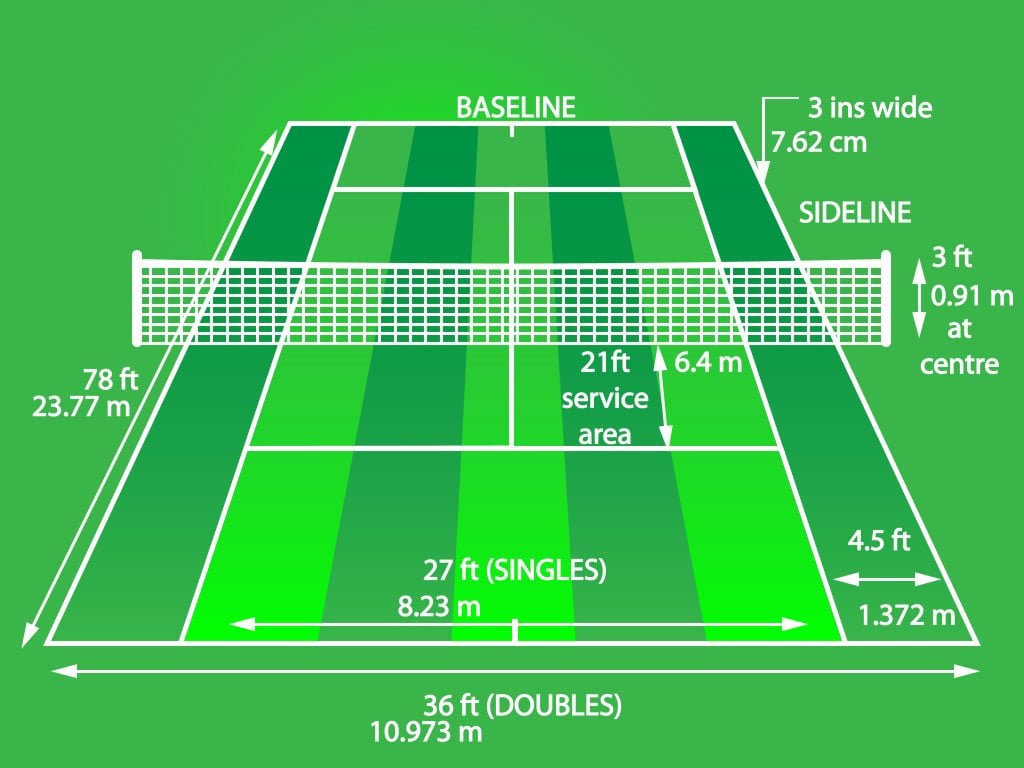
For any commercial or professional tennis court, the following dimensions are standard:
Singles Court: 78 feet long and 27 feet wide
Doubles Court: 78 feet long and 36 feet wide
Net Height: 3 feet at the center, 3.5 feet at the posts
Tennis Court Surfaces
The surface of a tennis court significantly impacts the pace of the game, bounce, and overall player experience. Here are the common types:
Hard Courts: Made of concrete or asphalt with an acrylic coating, hard courts offer medium ball speed and consistent bounce.
Clay Courts: Composed of crushed brick, shale, or stone, clay courts are slower, providing high bounce and favoring tactical play.
Grass Courts: The fastest surface, grass courts offer low, unpredictable bounce, demanding precision and agility.
Cushioned Acrylic Courts: These courts feature a cushioning layer beneath the acrylic surface, providing medium ball speed and enhanced shock absorption.
Over time, every surface type experiences wear from weather and regular play, making professional tennis court resurfacing an important part of preserving consistent ball bounce, traction, and player safety.
Maintaining Your Tennis Court
To ensure your court’s longevity and playability, regular maintenance is essential. This includes:
Cleaning: Removing debris like leaves, dirt, and standing water.
Inspection: Checking for cracks, fading, or uneven surfaces. Addressing these issues early with tennis court repair and resurfacing can help extend the life of the playing surface and reduce more costly repairs later.
Resurfacing: Periodically investing in tennis court resurfacing services helps restore the court’s performance, appearance, and long-term durability.
Need Expert Tennis Court Services?
Pro Track and Tennis offers over 30 years of experience in resurfacing and repairing commercial-grade tennis courts. Our team can help you with:
Court design and construction
Surface resurfacing and repair
Contact Pro Track and Tennis today for a free consultation and let us help you design, build, and resurface courts that inspire athletes and communities.
Get a Free Assessment for Your Court or Track
Our in-house crews have completed 1,000+ projects across 25+ states. Tell us about your facility and we will inspect the surface and give you a straight plan and quote.
Get Free Assessment
»
About the Author
Recent Blog Posts
Discover More →
•
8 min read
Plan your fall court and track resurfacing project: when to book, how budget cycles fit in, and how to sequence multiple surfaces.
•
8 min read
Your tennis court cracked again after resurfacing? Learn why reflective cracking happens and what actually stops an old crack from reappearing.
•
7 min read
Learn how tennis court resurfacing timing affects downtime, from weather windows to phasing multi-court facilities without closing everything at once.
•
7 min read
TYPTI vs. pickleball for clubs: court, equipment, and rules differences, plus a decision framework on adding TYPTI or switching entirely.
•
10 min read
How to host TYPTI at your club: equipment, court readiness, programming, marketing, and the revenue model, compared to pickleball benchmarks.