
Tennis Court Resurfacing
Tennis Court Budget Planning for 2027: A Guide for Courts and Tracks
Updated on
·
9 min read

Published by

Key Takeaways
A single tennis court resurfacing starts at $20,000, and a full court rebuild runs about $75,000 or more.
Track work ranges from $20,000 to $40,000 for minor ARMOR crack repair to $400,000 to $800,000 or more for a new track.
Base and drainage condition decide which budget line you need, so get the site assessment before the request is written.
Plan to resurface courts every 5 to 7 years. On a track, a structural spray lasts 5 to 7 years if the maintenance coatings get done.
The expensive mistake in a court or track budget usually happens before the money is approved. Someone carries over last cycle’s figure or takes a number over the phone, and the request goes to the board. The real condition of the base shows up after the vote.
Tennis court budget planning for 2027 works better in the other order. Find out which layer is failing and price that fix before you write the request. This guide gives you our current planning figures for courts and tracks and a 10-year forecast your board can follow.
Current planning figures: a single tennis court resurfacing starts at $20,000 for a local job with no prep work, and a full court rebuild runs about $75,000 or more. On a running track, minor ARMOR crack repair runs $20,000 to $40,000, a structural spray with restriping about $120,000, a full scrape and new mat $200,000 to $300,000, and a new track $400,000 to $800,000 or more. Base and drainage condition decide which of those lines you need.
Why a 2027 Request Needs the Assessment First
For a school in a northern state, a 2027 project usually means a summer 2027 project.
“We can’t install coatings below 60 degrees or on damp surfaces. For northern states, that means work windows are much shorter, mainly summer.”
Lance Laurent, President, Pro Track & Tennis
Coatings need a surface of 60°F or warmer, and the temperature can’t drop below 60°F overnight either. A run of cool nights can hold up a court that was ready to coat. If the approved figure covers a resurfacing and the assessment then finds a failed base, you have no spare season to go back to the board and still build next summer.
Across 1,000+ projects in 25+ states, the budget that goes wrong is rarely the one with the small number. It is the one written before anyone walked the court.
The order matters more than the figure.

The Three Budget Paths: Maintenance, Resurfacing, or Reconstruction
Every court project lands on one of three paths. Budgets go wrong when the request names one path and the court is on another.
1. Ongoing maintenance (operating budget)
Cleaning, minor crack sealing, patching and line touch-ups belong here. Done consistently, this work pushes the next resurfacing further out. It does nothing for base movement or drainage, and it can’t stand in for a resurfacing that is overdue.
2. Resurfacing (planned capital)
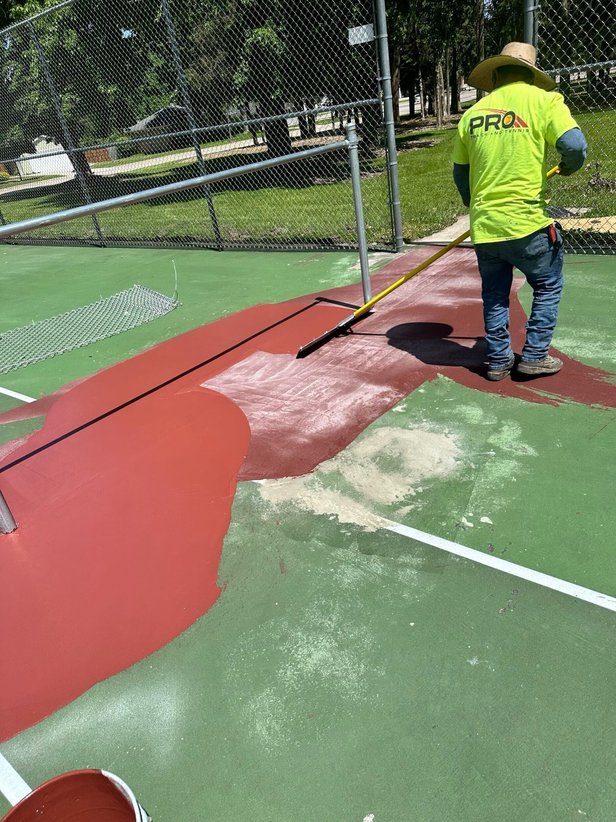
Tennis court resurfacing covers cleaning and prep, crack repair, new acrylic color coats and full striping. On a court with a stable base and working drainage, it brings back play for a fraction of the cost of a rebuild. Here’s the math: a single court starts at $20,000 to resurface and costs about $75,000 or more to rebuild. Plan for it every 5 to 7 years.
3. Reconstruction (major capital)
Reconstruction becomes the answer when the asphalt base has failed, drainage cannot keep up, the court is settling or heaving, or cracks return soon after every repair. The crew removes the surface and asphalt, rebuilds the base, regrades for drainage, then lays new asphalt and a new surface system.
Plenty of the rebuilds we quote started out as a resurfacing that got pushed back one cycle too many. Honest answer: some courts are past resurfacing, and we will tell you so.
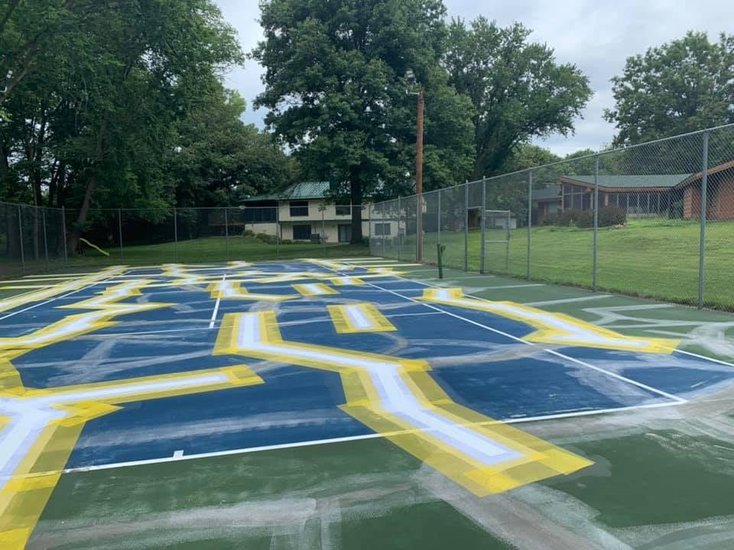
Current Planning Figures for Courts and Tracks
The figures below come from our current pricing. Treat them as planning numbers and confirm them with a site assessment before the request goes in, because condition and scope move every one of them.
Project | Planning figure | Notes |
|---|---|---|
Tennis court resurfacing, single court | From $20,000 | Starting price for a local job with no prep work |
Tennis court resurfacing with prep work | Approximately $20,000 and up | Crack repair and other prep add to the starting price |
Several courts in one project | Volume discounts available | Ask for the multi-court price |
Full tennis court rebuild, single court | About $75,000 or more | Base and drainage rebuilt |
Minor track crack repair (ARMOR) | $20,000 to $40,000 | Depends on the linear footage of cracks |
Track structural spray and restriping | Approximately $120,000 | Worn surface, sound mat and base |
Track full scrape and new mat | $200,000 to $300,000 | Failing mat, sound base |
New track construction | $400,000 to $800,000 or more | Depends on the scope of the build |
Court jobs take 5 to 10 days on site. Track resurfacing takes 2 to 4 weeks, and a new track takes weeks to months depending on scope.
Two items deserve their own line in the request. A cushioned surface such as Pro-Cushion adds cost per court, so ask for it priced separately. The same goes for pickleball court conversion on one or more of your tennis courts. Premium track systems and university-level work cost more again, and our running track resurfacing cost guide breaks out every tier.

What Drives Cost in Tennis Court Budget Planning
Four things set the real cost of a court project. Surface color is not one of them.
Drainage
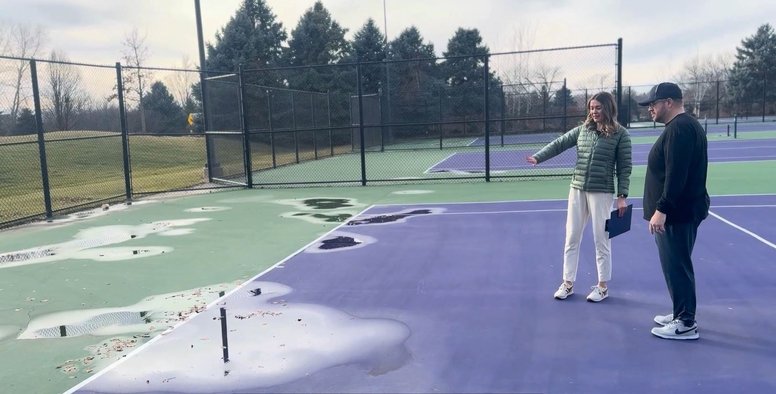
Water is the biggest long-term threat to a court. Once it gets into the base, the asphalt softens and freeze-thaw cycles force the cracks wider. Coatings start to separate. The court settles in places, and low spots called birdbaths hold water after every rain. Resurfacing over all of that buys a court that looks good for a short while. Then the cracks come back in the same lines, and the board asks why the money did not last. Water under the court makes it a structural job, so the budget has to start with drainage.
Base integrity
A court is a stack: surface, asphalt, stone and soil. If any layer moves, the surface follows it. Freeze-thaw climates and clay-heavy soils make base movement more likely, and a poorly compacted original build makes it more likely still. Our base evaluation is free, and guessing wrong can cost you a rebuild.
Timing
Resurfacing on schedule is maintenance. Resurfacing several cycles late is often reconstruction. “Let’s get one more season out of it” sounds like the cheap option. Why does one more season cost so much? Because water keeps working on the base whether anyone plays on the court or not, and that season can turn a resurfacing that starts at $20,000 into a rebuild at about $75,000 or more.
Climate
A court in Arizona and a court in Minnesota age differently. Freeze-thaw cycles open cracks and stress the asphalt. Heavy rain finds weak drainage quickly. We work in 25+ states across the Midwest, South, and Mountain West, so we match the surface system to where the court sits.
Budgeting a Track Alongside Your Courts
Track budgets follow the same logic at a much bigger scale. An average 8-lane track covers about 5,000 square yards (45,000 square feet), so every call carries more dollars. The question is which layer has failed, from the top coating down to the asphalt base.
Cracks in an otherwise sound surface: ARMOR crack repair. It buys time while you plan the next resurfacing.
A worn surface over a sound mat and base: a structural spray with restriping, which lasts 5 to 7 years if the maintenance coatings get done.
A failing mat over a sound base: a full scrape and new mat. With maintenance coatings every five to seven years, a new mat can last upwards of 20 years.
Standing water, soft spots or cracks through the asphalt: the base has failed, and resurfacing over it will not last.
ARMOR crack repair goes in at about 300 linear feet a day, so a badly cracked track can keep a crew on crack repair for days before any coating goes down. Our running track resurfacing page explains each option in more detail.
Building a new track instead of resurfacing? Our guide on how to budget for a new track installation covers what goes into that number.
We’ve walked school sites where the courts and the track came due in the same window and only one of them made the budget. Putting both in the same request, each priced, lets the board choose the order on purpose. Our fall court and track scheduling guide covers how to sequence the two.
How to Build the 2027 Budget Request
Step 1: Get a site assessment before the number goes in
Before a figure goes into the request, have someone check the base and drainage and map the cracks. Our on-site assessment is free, and it gives you something written to bring to the board. Without it, you are budgeting blind.
Step 2: Separate cosmetic wear from structural risk
Surface cracks from normal aging can be managed. Cracks that run through the asphalt need a different scope and a different budget line. Surface appearance alone will not tell you which kind you have.
Step 3: Put the options side by side
Ask for the resurfacing scope and the rebuild scope priced side by side, with prep work and any add-ons, such as cushion or pickleball conversion, as separate lines. What does the board actually need from you? Numbers it can compare. One figure on its own gets approved or cut. Two figures start a decision. If the work goes out to bid, check each response against our tennis court contractor RFP red flags.
Step 4: Build a 10-year forecast
Plan in 10-year cycles. Courts need resurfacing every 5 to 7 years, so a 10-year plan carries at least one court resurfacing and sometimes two. Tracks run on maintenance coatings: a structural spray lasts 5 to 7 years if they get done, and a new mat can last upwards of 20 years with coatings every five to seven years, so the plan should show when the next coating falls due. Forecasting this way keeps emergency projects off the table, and an emergency leaves no time to price options.
Common Budget Planning Mistakes Schools Make
Budgeting from a phone quote
Why can’t a contractor give you a firm price over the phone? Nobody can read a base from a desk. A phone figure leaves out prep work, and prep is where scope surprises come from.
Patching the same areas every year
If cracks keep coming back in the same zones, the base is moving or the drainage is failing. More patching there is temporary at best.
Treating resurfacing as cosmetic
Resurfacing protects the base. Put it off and water gets into the asphalt.
Hiring a contractor who subs out the work
Court work is not general paving. The wrong crack system or poor base prep will shorten the life of a new surface. Look for an ASBA member with in-house crews. We use our own crews on every project, because quality control leaves the site with a subcontractor.
When to Resurface vs. When to Rebuild
Look for patterns across the whole court.
Resurfacing usually fits when:
Cracks are manageable and do not run through the asphalt
The base feels firm across the whole court
Water drains off after rain
You see no widespread settlement
Reconstruction becomes necessary when:
Cracks are structural and widespread
The court feels uneven or soft underfoot
Water stands on the court long after rain
Crack repairs fail soon after they go in
The call needs a site visit. A photo and a quote can’t make it.
Frequently Asked Questions
How much should a school budget to resurface a tennis court?
A single court starts at $20,000 for a local job with no prep work. Prep such as crack repair adds to that, and multi-court projects can qualify for volume discounts. A free on-site assessment gives you the figure for your courts.
How often should school tennis courts be resurfaced?
Every 5 to 7 years. Where your courts fall in that range depends on usage, climate and maintenance.
What does it cost to resurface a school running track?
A structural spray with restriping costs approximately $120,000. A full scrape and new mat runs $200,000 to $300,000. Minor crack repair alone runs $20,000 to $40,000, depending on the linear footage of cracks.
Can we delay resurfacing another year?
Sometimes, but only after someone has checked the base and drainage. The longer it waits, the more likely a resurfacing scope turns into a rebuild.
How do we know if our base is failing?
Cracks that come back in the same places and soft spots underfoot are early signs. So is water that stands on the surface long after rain. A site assessment confirms it and gives you something concrete to act on.
What should we look for in a court or track contractor?
An ASBA member with in-house crews, a written warranty, a site visit before the price, and references from projects like yours. Our resurfacing work carries a 2-year workmanship warranty, and ARMOR crack repair on courts carries a 5-year warranty.
Bottom Line: Tennis Court Budget Planning Is About Timing
The cheapest court or track in a 2027 budget is the one priced from a real assessment. Resurface too early and you pay for surface life you still had. Resurface too late and you pay for a new base. Good tennis court budget planning puts the assessment before the request, so the number the board approves matches the work the site needs.

Schedule a Free Assessment with Pro Track & Tennis
If you are writing a 2027 request for courts, a track or both, start with a free on-site assessment. We’ll check the base and drainage on site and tell you which path each surface is on before you put a number in front of the board.
Pro Track & Tennis has 30+ years of experience and 1,000+ completed projects across 25+ states. ASBA member. In-house crews.
Call 800-498-4395 or email info@protrackandtennis.com.
Get a Free Assessment for Your Court or Track
Our in-house crews have completed 1,000+ projects across 25+ states. Tell us about your facility and we will inspect the surface and give you a straight plan and quote.
Get Free Assessment
»
About the Author
Marketing Manager, Pro Track & Tennis
Recent Blog Posts
Discover More →
•
8 min read
Plan your fall court and track resurfacing project: when to book, how budget cycles fit in, and how to sequence multiple surfaces.
•
8 min read
Your tennis court cracked again after resurfacing? Learn why reflective cracking happens and what actually stops an old crack from reappearing.
•
7 min read
Learn how tennis court resurfacing timing affects downtime, from weather windows to phasing multi-court facilities without closing everything at once.
•
7 min read
TYPTI vs. pickleball for clubs: court, equipment, and rules differences, plus a decision framework on adding TYPTI or switching entirely.
•
10 min read
How to host TYPTI at your club: equipment, court readiness, programming, marketing, and the revenue model, compared to pickleball benchmarks.